Amy Goodrich: Hello and welcome to part two of our roundtable discussion on “A Case-Based Discussion of BTK Inhibition in CLL.” I'm Amy Goodrich. I'm a nurse practitioner at the Johns Hopkins Kimmel Cancer Center in Baltimore, Maryland. Joining me are my two colleagues, Mollie Moran and Jill Miller. Mollie is a nurse practitioner at the James Cancer Hospital at The Ohio State University Medical Center, and Jill is a physician associate at MD Anderson Cancer Center in Houston, Texas. Thank you both for joining me today. I will let Mollie take it away to talk about this case study.
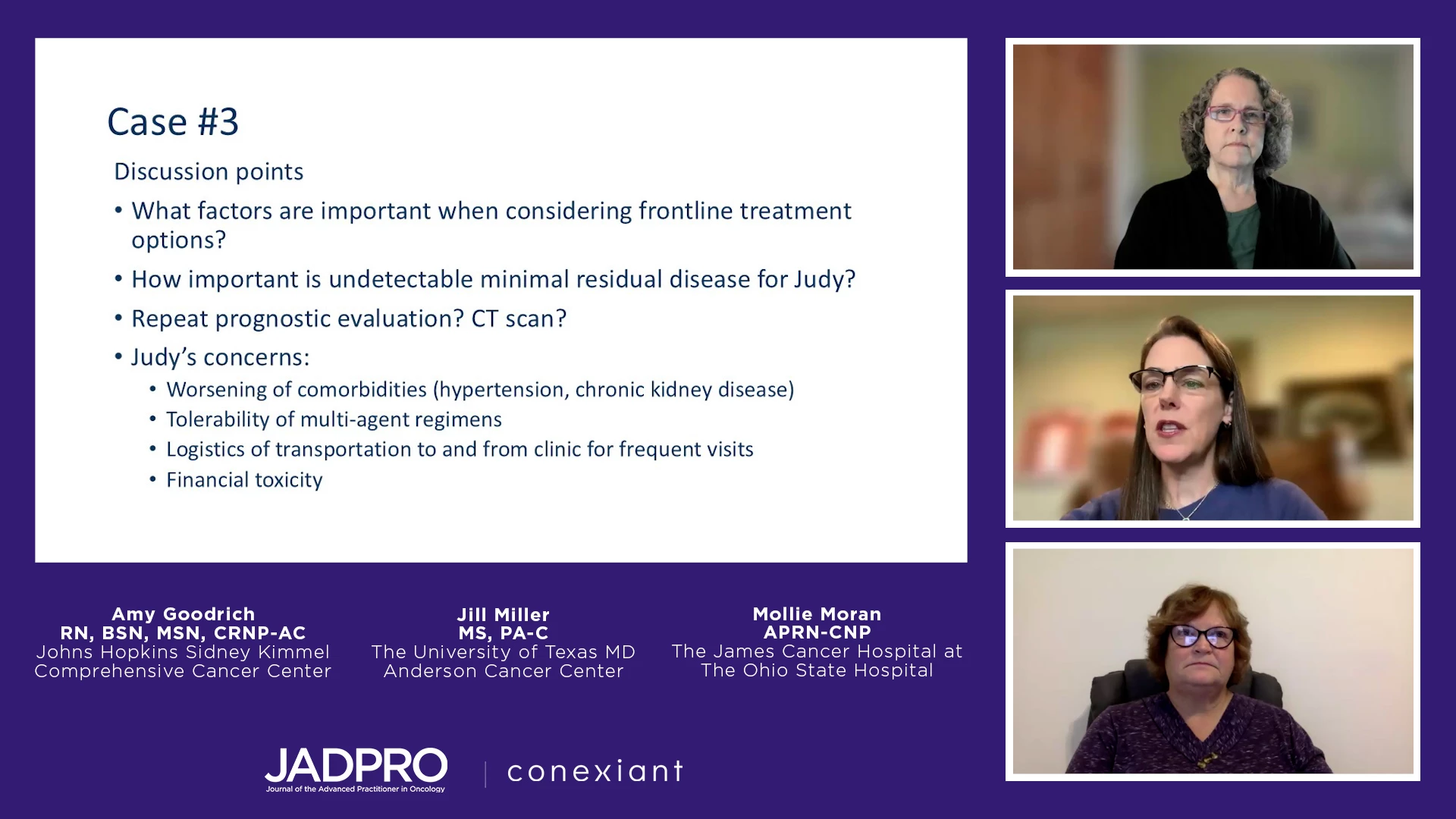
Mollie Moran: Thank you, Amy. This case study is about initial treatment and intolerance in BTK therapy in a CLL patient. Mr. J is a 75-year-old gentleman with a history of previously treated CLL with chemoimmunotherapy. He does not have a deletion 17p, nor does he have a TP53 mutation. His disease is unmutated. He has comorbidities of hypertension, chronic kidney disease, he's currently on amlodipine and atorvastatin. He comes to his local oncologist who sees him for recurrent disease, and he's got a rising white blood cell count, increased lymphadenopathy, rising ALC, and his platelets are down to 96 and his hemoglobin is dropped into the nines. He has some reported fatigue and is not able to do the things that he likes to do, which is golfing and working in the yard and shuttling his wife around from store to store. They may not be high on his list of things he likes to do, but he does it lovingly.
So they initially start him on a covalent BTK inhibitor for what's considered a symptomatic relapse. He starts on therapy, and after about 4 weeks, we see a trend in the white count to go up in the lymphocytosis, which is normal with the start of a BTK inhibitor. And then eventually that starts to come down, and his lymph nodes resolve and his platelets start to rise. Amy, what kind of timeframe or what kind of observations or labs and stuff do you do when you initiate someone on a BTK inhibitor?
Amy Goodrich: Yes, I think that it varies by patient, but in general, I like to see weekly labs when people first get started. Because like you're saying, the lymphocyte count can spike up, people can have pretty dramatic shifts in their counts. And as long as the lymph nodes are reducing in size, you can feel pretty confident that this is just the drug and those lymphocytes pushing out of the lymph nodes and into the peripheral blood. But I really like to keep a close eye on people initially. I tend to do weekly labs, and this is a great place to do telemedicine visits just to make sure folks are not having a lot of nausea or diarrhea or all those things that we can see with those BTK inhibitors, just to launch them successfully and get them on autopilot so that you can get on those every-3-month visits.
Mollie Moran: Good, good, agree. Thank you, that's great. And I agree, you know, weekly labs in the beginning, lots of checking in, "How you doing? How are you tolerating?" After about 8 weeks, he's seen in the emergency room for feeling like his chest is fluttering, like his heart's pounding out of his chest. And when he's evaluated, they find that he has a new onset of AFib with a ventricular rate in the 120s, his hypertension is worse, he's 162/94, and he has grade 2 easy bruisability. So with this new diagnosis of atrial fibrillation, Jill, what do you tell your patients to look for, for this possibility, and what do you tell them about the likelihood of developing an atrial fibrillation or another common side effect in these drugs?
Jill Miller: Sure. I mean, these are known side effects, so the important thing is to educate patients early on as they start therapy, to be on the lookout, because some patients may not even be aware of an irregular heartbeat. But to tell them the symptoms to look for, such as the feeling that their heart is racing, feeling maybe some dizziness, shortness of breath, just feeling not quite right, which gets to the importance of these weekly check-ins with patients to help them know whether anything that they're experiencing may be related to the medication. And also have them check their blood pressure regularly to look for any changes from their baseline values there. But just really identifying these potential side effects early. Some are more significant than others. The easy bruising, easy bleeding, is something that we can generally manage through, but certainly when patients start to develop cardiac toxicities, that should prompt a discussion of whether or not we should hold the medication and maybe switch to a different agent.
Mollie Moran: Thank you. That was a wonderful segue into the next part of his case study. So agreed, so he's evaluated for these toxicities and they want to start him on anticoagulation. And so they call the oncology office and they want to know what's recommended and what should be allowed to be done for his anticoagulation. They've given him some heparin in the ER and they want to know what to do with his CLL meds as well. And so we know that warfarin is contraindicated in these categories of drugs, but the DOACs are okay. And so he gets started on apixaban in the ED and they give him some metoprolol for rate control, get his blood pressure all squared away and send him out and he goes back to the cardiologist's office. So in addition to doing these workups, we would generally send, or what they've done in the ER, we would generally consult with or have them evaluated by cardio-oncology, because they have a strong interest in these mechanisms between BTK inhibitors and arrhythmias.
And so the more data we can collect in that realm, and they're also very helpful at managing their medicines in terms of rate control, anti-hypertensive. If you have trouble regulating their blood pressure and you get up beyond two or three anti-hypertensives, it's going to be time to change therapies to a completely different category. So his drug gets changed to acalabrutinib. There are some studies that show clearly that there's less likely chance of having hypertension with another one of the BTK inhibitors like acalabrutinib or zanubrutinib, both well tolerated, both may have a little bit less side effects.
Amy, do you have a preference to which of the next ones he switches to?
Amy Goodrich: Well, in terms of the AFib, we know from head-to-head studies that ibrutinib has a higher AFib rate than both acalabrutinib and zanubrutinib, but we also know from head-to-head studies that the hypertension rate is equal between ibrutinib and zanubrutinib, but it is lower with acalabrutinib. And so since this guy did have both hypertension and AFib, I do think acalabrutinib is the, you know, from the data we have from these head-to-head studies, acalabrutinib has the lower both AFib and hypertension rates. Although zanubrutinib is certainly not a bad choice, given this guy's profile, I think acalabrutinib has better numbers for both AFib and hypertension.
Mollie Moran: Amy, do you have any thoughts on which next BTK he would go onto? Or what goes into the thought of managing these side effects, and what do you do with the next treatment?
Amy Goodrich: Well, I think that we know that we have this head-to-head data that shows that tolerance is different, based on each of these drugs, but our NCCN guidelines relatively recently encouraged us to completely work through a drug class before switching drug classes. So we know that even patients who need dose reductions stay on drug longer, they have good outcomes. So really not abandoning a drug class, but really because he's responding, trying to figure out a good covalent BTK inhibitor regimen for him is better than just throwing in the towel and going to something else.
Mollie Moran: His therapy is actually changed over to acalabrutinib, which he's on for a few months, and his AFib is well-controlled, his blood pressure is looking better, but he starts to complain of ongoing headaches. And the workup is neurologically negative, no bleed or anything like that, and so he then gets changed over to zanubrutinib. And he tolerates that well. No headache, all of his other symptoms are fine, he's going about his daily business, golfing all the time.
And then he comes to the office and he's got some increasing lymphadenopathy and some rising white count and some lowering platelets, but LDH is normal, so we're not concerned about Richter's, this isn't a rapid growth in his lymphadenopathy. And so the next step is to think about what could we possibly do next. He gets some cytogenetic testing done, and now he has he has a BTK resistance mutation that's developed over the course of the last year as well. Jill, how often are you guys checking for BTK resistance mutations?
Jill Miller: Well, really we're only checking when we suspect that they may be developing resistance and they may be losing response. So in this scenario, this would be an appropriate time to look for those mutations.
Mollie Moran: Amy, do you monitor resistance on a regular basis?
Amy Goodrich: It depends on the patient. If this is a 90-year-old guy, we're not necessarily as aggressively checking as people who really do have a very deep bench of options and are going to be around for a long time. So you sort of have to temper that, but what I always think about when people come, like you're saying, he comes back and it looks like he's progressing, is he really taking the drug? Right?
Is he being adherent, is he taking it right? He's somebody who's had some issues with previous BTK inhibitors, the previous agents. That's always front and center in my mind as well, but I'm assuming you figured that out. But yes, he is somebody that if he's taking his drug, we should be looking for resistance mutations.
And also checking all of his prognostics again, because he could be developing a TP53 abnormality. He didn't have any of those high risk features, he could have a 17p deletion, he could be developing additional mutations.
Mollie Moran: Yes, all good points. And I like the teaching point of, is he taking the medicine? "I know you've got a bunch of other medicines for your high blood pressure and your AFib and now the anticoagulation, and you're trying to stay busy and you're out on the golf course. And so yes, are you taking your medicines?" Always something we ask, "How compliant are you?"
So, he ends up getting switched to a non-covalent BTK inhibitor because of this new resistance mutation. And so he gets put on pirtobrutinib. And looking back through some of the recent studies and the published data, a lot of times these side effects are when you switch to another BTK inhibitor, things like hypertension, AFib, they're not necessarily more likely to happen on the new one or to recur, and so you're not accumulating risks for hypertension or risks for worsening atrial fibrillation.
So, he's on zanubrutinib and he's tolerating it well, and the plan is to look at him for potential biologic therapy with either a bispecific antibody or CAR-T therapy at his next relapse. So in terms of watching him between now and that point, what kind of monitoring do you tell patients to do in terms of their vaccines and their screenings? Jill, what about you?
Jill Miller: Yes, so the topic of vaccinations, of course, has taken on a whole new level of controversy, but we still promote regular vaccinations with annual flu shots, pneumococcal vaccinations, Shingrix. We try to avoid giving vaccinations if patients are receiving a CD20 antibody or if they're in the middle of limited duration treatment. If at all possible, they're going to get a much better response if they're not getting those agents, but we do promote those as well as all other health maintenance things such as regular blood pressure checks, scheduled colonoscopies, PSA checking, etc. So we're always reinforcing all those preventive measures with our patients.
Mollie Moran: Amy, any additional screening or testing or checking that you do along the way as the course of pirtobrutinib continues?
Amy Goodrich: Well, just that lab monitoring, just keeping a close eye on folks. But all that health maintenance and vaccination, anything preventative, we really encourage patients to do and to get, and still seeing their primary care provider, which they love to stop doing.
Mollie Moran: That is the truth. One other screening that I wanted to stick in there is that we do skin cancer screenings, annual dermatology visits as part of that screening.
Jill Miller: Yes.
Mollie Moran: So, we'll leave Mr. J with his pirtobrutinib and end this case study. And I thank you for your input, both.
Amy Goodrich: Great. Thank you, Mollie. So, this concludes our roundtable “A Case-Based Discussion of BTK Inhibition in CLL.” I would like to thank Jill and Mollie for joining me, and for more information and to view our other case discussions on this topic, please visit JADPRO.com.