

A Case-Based Discussion of BTK Inhibition in CLL
Part 3: Managing Frontline BTKi Strategy and Logistics
Amy Goodrich, RN, BSN, MSN, CRNP-AC, Jill Miller, MS, PA-C, and Mollie Moran, APRN-CNP, discuss frontline BTKi selection for a 79-year-old patient with CLL, hypertension, and logistical barriers. The faculty discussed and favored indefinite therapy using the second-generation covalent BTKi zanubrutinib due to its simplicity and better toxicity profile compared to ibrutinib. They emphasize weekly initial monitoring and educating patients on the three main side effect risks: A-Fib, hypertension, and bleeding.
Chair

Amy Goodrich, RN, BSN, MSN, CRNP-AC
Johns Hopkins Sidney Kimmel Comprehensive Cancer Center
Faculty

Jill Miller, MS, PA-C
The University of Texas MD Anderson Cancer Center

Mollie Moran, APRN-CNP
The James Cancer Hospital at The Ohio State Hospital
Transcript
Amy Goodrich: Hello and welcome to JADPRO's roundtable discussion titled “A Case-Based Discussion of BTK Inhibition in CLL.” I'm Amy Goodrich. I'm a nurse practitioner at the Johns Hopkins Kimmel Cancer Center in Baltimore, Maryland. Joining me are two of my colleagues, Jill Miller and Mollie Moran. Jill is a physician associate at MD Anderson Cancer Center in Houston, Texas. And Mollie is a nurse practitioner at the James Cancer Hospital at The Ohio State University in Columbus, Ohio.
Thanks again for joining me today. In this video roundtable discussion, we will be focusing on our final case study. Jill, do you want to discuss our next case?
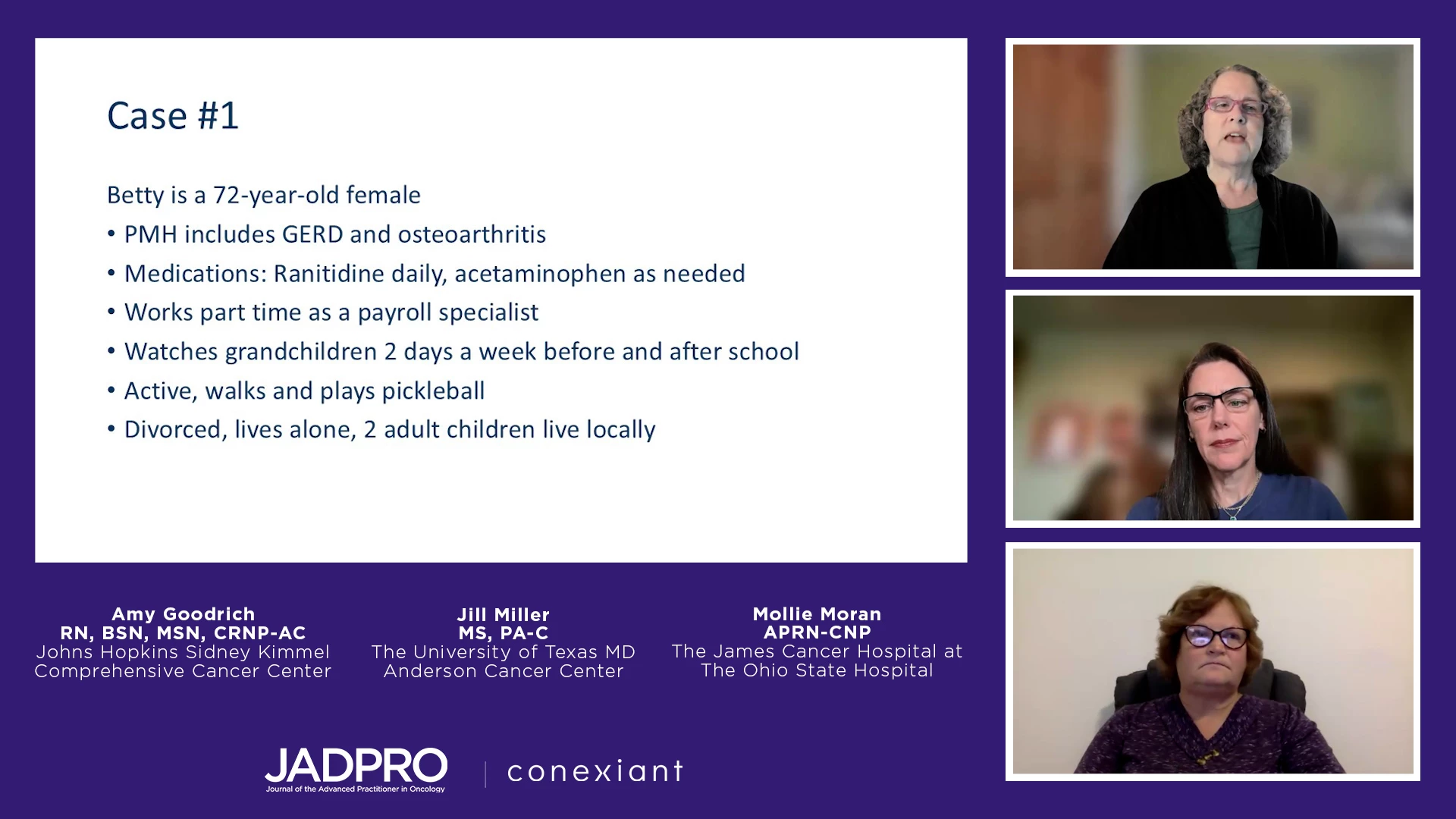
Jill Miller: Sure. Thank you, Amy. So our next case is a woman by the name of Judy. She's 79 years old. She was diagnosed with CLL 5 years ago, and she's just been under active surveillance and sees her oncologist every 6 months. Her prognostic features include deletion 13q and trisomy 12 by FISH. She has an unmutated IGHV gene and normal karyotype. Her past medical history includes hypertension and stage three chronic kidney disease. The medications that she takes include valsartan with hydrochlorothiazide and empagliflozin, temazepam, and vitamin D.
She's retired. She's a widow, and she helps to care for her great-grandchildren after school. She lives in the retirement community that is about 2 hours from her clinic, and she prefers not to drive after dark.
So she shows up for her regular follow-up visit and she has progressive disease. Her CBC at this visit shows a white count at 38, which is 88% lymphocytes. Her hemoglobin is 9.8 and platelets are 102. She also has symptomatic lymphadenopathy with difficulty swallowing. She has abdominal discomfort, and she has palpable nodes in the cervical supraclavicular and axillary lymph node basins. She's also complaining of significant fatigue to the point that she can no longer help care for her great-grandchildren, and therefore, she does meet iwCLL indications for treatment.
for this patient, Amy, what factors are important to you with a patient such as Judy when you're considering frontline treatment options?
Amy Goodrich: Right, so she is a lady who is on the older side who lives of distance from her care center. And so really that is prohibitive and she doesn't drive after dark or doesn't drive at night. So this is somebody I would be thinking about a covalent BTK inhibitor and not something that required infusions or frequent TLS monitoring, really trying to make life as normal for her as possible.
Jill Miller: Right, right. And Mollie, as you consider treatment options for her, how important is the idea of achieving undetectable minimal residual disease?
Mollie Moran: I think it's important in anyone that we treat. However, the data shows that we can get 10+ years out of some of these BTK inhibitors and the landscape may look a lot different than it does now. So it would be nice, but would it be the end all do all? I don't think so. I think you would continue the therapy whether if her disease is well-controlled and she's feeling well and she's tolerating it, I don't know that minimal residual disease detection or lack of minimal residual disease would actually change your overall game plan at this point.
Jill Miller: And at this point, would you repeat her prognostic evaluations or any testing you would add?
Mollie Moran: I don't believe I would.
Jill Miller: Okay. Amy, would you do a CT scan at this point?
Amy Goodrich: I would do a CT scan. If she's having trouble, and you could even consider a PET scan for this lady because she is having symptoms and that difficulty swallowing. Even though the rate of Richter's is low in CLL, it is something that we should always be thinking of. And I think this lady's adenopathy is worrisome enough that you could justify doing a PET on her to make sure she doesn't have transformation.
Jill Miller: Sure, sure. Good point. So Judy's concerns as we begin to discuss treatment options, she's very concerned that any treatment that we put her on is going to worsen her blood pressure, worsen her kidney disease. She's concerned about whether or not she could tolerate a regimen that has multiple agents. And of course, she's concerned about just the logistics of transportation, getting to and from her clinic visits. And also, of course, she's concerned about the cost of treatment and what her out-of-pocket cost will be.
So when we look at consideration of frontline choice, and first of all, we're in a completely new era where we actually have so many choices available, which is very different from when I first started taking care of CLL patients 18 years ago. So it's a blessing to have so many choices, but what we take into consideration for each patient, we take into consideration their age, their comorbidities, whether they have any cardiac comorbidities, whether they're taking any anticoagulation medications.
We think about their kidney function as we consider the potential risk of tumor lysis syndrome. We think about the burden of their disease, how high is their white count, how big are the lymph nodes, and the impact to potential TLS risk. Then of course, we're going to consider patient preference, whether they prefer a strictly oral regimen or if they're willing to consider adding IV administration of a CD20 antibody.
And then, just the logistics that they're facing, whether they have a long drive to deal with, if they have caregiver support, and then whether the oncologist who will be providing the care can provide the appropriate TLS monitoring in the outpatient setting, and whether they have the ability to admit a patient, if they are considered high risk for TLS. And then finally, the financial toxicity considerations and whether we have access to the newer drugs and what type of insurance coverage they have.
So when we look at the NCCN preferred regimens in the frontline setting, we can look at indefinite therapies vs fixed duration therapies. And the indefinite therapies are going to be in the frontline setting, the covalent BTK inhibitors that we've already been discussing. So acalabrutinib with or without obinutuzumab, zanubrutinib. Ibrutinib is actually no longer one of the preferred regimens due to its inferior toxicity profile as well as inferior efficacy compared to the second-generation BTKis.
With the fixed duration therapies, we have approval for venetoclax in combination with obinutuzumab for 1-year duration. And with the AMPLIFY study, we have recognition of the triplet of venetoclax with acalabrutinib and obinutuzumab, which does not yet have approval, but is certainly recognized now in NCCN guidelines. So, as we compare the pros and cons of indefinite therapy vs fixed duration, obviously, with the indefinite BTKi therapy, it's simpler, it's easier, it's a single drug.
You have a lower risk of TLS, and there's data to support superior outcomes for patients that have TP53 aberrations or deletion 17p. The drawback to indefinite therapy is it's indefinite. And so, patients are going to be on it long term until they progress or develop intolerance. And you also have lower risk of complete remission and undetectable MRD. With the fixed duration regimens, obviously, you have a treatment-free interval to look forward to.
Upon achieving remission, you have the greater potential for a deep remission and reduce cumulative toxicity and resistance. The disadvantages of the fixed duration is they're just, as Mollie pointed out earlier, you have a higher lead-in in terms of frequency of visits and monitoring, higher risk of TLS, and you also have a greater risk of the more severe cytopenias.
So, when we look at the data of BTK inhibitors, as I mentioned earlier, the ibrutinib is no longer one of the preferred regimens. So, comparing the second-generation BTKis, we only have two studies that do head-to-head comparisons. We have the ELEVATE-RR study, which compares acalabrutinib vs ibrutinib. And then, we have the ALPINE study, which also compared ibrutinib this time against zanubrutinib. Both of these studies showed lower risks of toxicity with the second-generation BTKis and the ALPINE study actually confirmed better efficacy with zanubrutinib over ibrutinib.
We don't yet have any head-to-head comparisons of acalabrutinib vs zanubrutinib, but just some differences between those two medications. The dosing can be twice daily with either one of them. Zanubrutinib also offers the possibility of single once-daily dosing. There was an article published in Lancet in 2023 that may be hinted at evidence to support the use of zanubrutinib following intolerance with acalabrutinib, but that was very limited number of patients, so more data is certainly needed there to compare those two.
So, Judy takes all this into consideration, and she decides to go with indefinite therapy with a second-generation BTKi. So, Mollie, what are the key education points as you talk to Judy about starting treatment with a BTKi? What side effects should she be aware of as she starts therapy?
Mollie Moran: Whenever I talk to a patient about a BTK inhibitor, I always talk about the biggest three frontrunner risks of developing these side effects, including an irregular heartbeat or atrial fibrillation, and then talk about how they may not know that they're having atrial fibrillation, but they may feel like their heart is beating irregular or they get short of breath, and that needs immediate attention either in an urgent care or in an ER or in our office.
The second one is an elevation in blood pressure, so hypertension is always a concern. And the third one is bleeding risk. We expect that you'll have bruising. We expect that you'll have a little bit harder to stop if you get a nick in your skin, but then we talk about the other symptoms or signs that you could be having bleeding–blood in your urine, blood in your stool, bleeding gums that won't stop bloody nose, certainly any neurologic changes, evaluation in ER right away.
Jill Miller: Great.
Mollie Moran: Compliance, take the pills.
Jill Miller: Very important. Very important. And Amy, how close are you going to follow her as she starts therapy? How frequently are you going to check labs and touch base with her about tolerance and compliance?
Amy Goodrich: Yes. I tend to do that weekly initially for the first at least 3 or 4 weeks just to make sure that people are getting off on a good foot, that they're not having, and folks can have nausea, they can have diarrhea, some GI toxicity as well. Just making sure that if they're having lymphocytosis, that I'm seeing that and their counts aren't shifting significantly or in a worrisome way. And then, just making sure that they are well-controlled with any side effects that they're having.
And then, the goal is to see them every 3 months. But initially, I do weekly just to make sure folks are getting off to a good start.
Jill Miller: And how often are you coordinating care with perhaps a primary care physician? If there's a willing provider that's closer to where your patient lives, do you do that type of care coordination as patients start therapy?
Amy Goodrich: That is certainly a consideration if folks live a distance. And what I tend to pick up the phone and call primary care providers and other providers about is when we have drug-drug interactions as well, just making sure that there's no wiggle room for them to switch them off other things. But I really make sure that those primary cares are getting notes and that if there's any additional monitoring that I need the primary care to be doing or picking up on that I am making contact and asking them to pair with us. Most are more than happy to do so.
Jill Miller: And I imagine also educating them on the likelihood of lymphocytosis as they start therapy so that they don't become shocked by those high white counts.
Amy Goodrich: Yes.
Jill Miller: And then Mollie, how often are you restaging? So this is a patient that presented with bulky lymphadenopathy. We did a baseline CT scan. Are you going to be repeating that as she goes through therapy and doing any MRD testing along the way?
Mollie Moran: After about a year on therapy, and if her counts normalize, then we may consider doing a repeat of her CAT scans. If her CAT scans are negative, then maybe do MRD testing. If she's completely asymptomatic and she's tolerating therapy and the plan is to keep her on this for the long haul, then we may not go as far into looking for minimal residual disease as we would if there was another plan to maybe switch her to a time-limited therapy or move things around.
Jill Miller: And at what point would you consider either adding another agent or switching therapy? At what point would you decide that you're not getting an adequate response?
Mollie Moran: I think if you had almost no response at 3 months, then you would have to say maybe this isn't the right drug. But you can have lymphocytosis for over a year and people who have lymphocytosis at the 1-year mark still do as well as people who don't have lymphocytosis at a year. So that's not a good gauge. It's really, if she's still symptomatic and her counts aren't improving, then you might want to think about changing therapies.
And that could be anywhere along the line, but at least a good 3 months before you would say this isn't working.
Jill Miller: Yes, yes. And Amy, are you checking for any resistance mutations as she goes for treatment?
Amy Goodrich: Not if she's responding. So, like Mollie is saying, even if she has lymphocytosis, if her other counts are heading in the right direction and those nodes are reducing in size and there's no reason to think she's progressing, there's really no reason to go looking, I think. In my practice, we're not looking for measurable residual disease or resistance mutations on people who are responding.
Jill Miller: Great. Great. Well, Judy opts for indefinite therapy and she decides to go on zanubrutinib and I’m happy to say that a year into treatment, she's responding very well and is able to get assistance through foundations so that she can afford the medication, which is always a concern for patients. So happy to say she's doing well.
Amy Goodrich: Great. Thank you. So this concludes our discussion of today's case study. I would like to thank Jill and Mollie for joining me. For more information and to view our other case discussions on BTK inhibition in CLL, please visit JADPRO.com.