

The Diagnosis, Management, and Evolving Treatment Landscape of Follicular Lymphoma
Case 2: Updates and R2 Combinations in Second-Line Follicular Lymphoma Treatment
Kimberly Grazier, DNP, AGPCNP-BC, Allison Karabinos, PharmD, BCOP, and Susan Woodward, MSN, APRN, AOCNP®, discuss evolving second-line treatments for follicular lymphoma, focusing on the R2 regimen, tafasitamab-R2, and epcoritamab-R2. They review clinical data from the AUGMENT, inMIND, and EPCORE FL-1 trials, highlighting significantly improved progression-free survival in relapsed settings. Using a case study of a patient refractory to initial therapy, the experts evaluate critical decision-making factors such as patient fitness, support systems for managing cytokine release syndrome, and access to tertiary care centers. They also emphasize the importance of monitoring receptor expression and considering future eligibility for CAR T-cell therapies.
Chair

Kimberly Grazier, DNP, AGPCNP-BC
Atrium Health Levine Cancer Institute (Advocate Health)
Faculty
Allison Karabinos, PharmD, BCOP
Atrium Health Levine Cancer Institute (Advocate Health)

Susan Woodward, MSN, APRN, AOCNP®
Moffitt Cancer Center
Transcript
Kim Grazier:
Welcome to this Virtual Roundtable on what advanced practitioners need to know about the diagnosis, management, and evolving treatment landscape of follicular lymphoma. I'm Kim Grazier and I'm a nurse practitioner at Advocate Health. Joining me today for this discussion are Allison Carabinos, a pharmacist and my colleague at Advocate Health, and Susan Woodward, a nurse practitioner at Moffitt Cancer Center. Thank you so much for joining me today.
Today, Allison is going to get us going with a discussion focused on second-line therapies, specifically the R2 regimen, tafasitamab, and epcoritamab R2 as a novel bispecific T-cell engager combination, as well as a case study of an older woman diagnosed with stage IV classic follicular lymphoma. Allison, why don't you get us started?
Allison Carabinos:
I will be reviewing treatment updates in follicular lymphoma in the second-line setting. Guideline-directed second-line treatment options are listed below. There are a few pearls to consider in the second-line setting or with any follicular lymphoma relapse, one being the importance to re-biopsy if there's clinical suspicion for transformation to a large B-cell lymphoma. This could include things like high SUVs on a PET scan, rapid progression of lymphadenopathy, the presence of B symptoms, as well as a very high LDH. If large B-cell lymphoma was confirmed on biopsy, the patient should be treated as a large B-cell lymphoma.
There's also consideration around the timing of follicular lymphoma relapse. There's a unique subgroup of follicular lymphoma patients called POD24, and these are patients who have progressive disease within the first 24 months of initial chemoimmunotherapy. They make up around 10–20% of follicular lymphoma patients and are associated with poor overall survival, highlighting this difficult-to-treat population. But as Kim mentioned, I wanted to focus today on tafasitamab R2 and epcoritamab R2 given their recent approvals in the second-line treatment setting of follicular lymphoma.
R2, or lenalidomide and rituximab, was first approved in 2019 and became a commonly utilized second-line treatment regimen. Since then, monoclonal antibodies have been incorporated and added to the standard R2 backbone in the second-line setting. In June 2025, the addition of tafasitamab to R2 was approved by the United States FDA. Then in November of 2025, epcoritamab was added to R2 and this combination was approved in the relapse refractory lymphoma setting.
Looking first at R2, we know rituximab is administered weekly in cycle 1 and then monthly through cycle 5 with Revlimid administered orally for 21 days on and 7 days off for a total of 12 cycles. R2 was first approved by the United States FDA based on the results of the multicenter double-blind randomized phase 3 AUGMENT study. There were 358 patients with relapsed/refractory follicular lymphoma or marginal zone lymphoma included, of which 295 patients had follicular lymphoma. These patients were randomized to receive one-to-one R2 or rituximab monotherapy.
Initial AUGMENT study results demonstrated a significant improvement in the primary endpoint of progression-free survival in the R2 group, and then 5-year results presented after a median follow-up of nearly 66 months maintained the significant improvement in progression-free survival with median PFS of 27 months vs 14 months. The 5-year overall survival rate was 83% in the R2 arm and 77% with rituximab alone. Infections, cutaneous reactions of thrombocytopenia, were more common with R2 and neutropenia and leukopenia were the most common grade 3 and 4 toxicities.
Moving on to tafa-R2–its schedule is included here. Tafasitamab is a CD19-directed monoclonal antibody and was added to the standard R2. Tafasitamab is administered weekly for the first 3 cycles, then every other week for the remaining 9 cycles of treatment for a fixed total duration of 12 cycles also. Tafasitamab-R2 was approved by the United States FDA based on the results of the double-blind randomized phase 3 inMIND study. 548 patients with relapsed or refractory follicular lymphoma were included and randomized one-to-one to receive tafa-R2 or R2 alone. After median follow-up of 14 months, the primary endpoint of median progression-free survival was not reached in the tafasitamab R2 arm vs 16 months in the R2 group. This was a statistically significant finding, and this PFS benefit was consistent across all subgroups, including those with POD24. Tafasitamab-R2 also resulted in a higher overall response rate of 84% compared to 72%, and the complete metabolic response of tafa-R2 was 49%. Adverse events, including neutropenia and infection, were similar between arms.
Lastly, looking at epcoritamab-R2, its schedule is also included on this slide. Epcoritamab is a bispecific CD20-directed CD3 T-cell engager. It was added to standard R2. Epcoritamab is administered weekly for the first 3 cycles, similar to tafasitamab; however, it then transitions to monthly dosing for the remaining 9 cycles for a fixed total duration of 12 cycles. Due to the risk of cytokine release syndrome, or CRS, and neurotoxicity, including ICANS, epcoritamab is administered via a 3-step-up dosing schedule in cycle 1 to mitigate these risks.
Epcoritamab was approved by the United States FDA based on the results of the open-label randomized phase 3 EPCORE FL-1 study. 488 patients with relapsed or refractory follicular lymphoma were included and randomized one-to-one to receive epcoritamab-R2 vs R2. Particularly, the results reported in the EPCORE FL-1 study included the arm of epcoritamab that received the treatment dose of 48 milligrams. After a median follow-up of 14 months, the dual primary endpoint of median progression-free survival was significantly improved in the epcoritamab-R2 group. It was not reached compared to 11.7 months in the R2 group. Its PFS benefit was also shown across all pre-specified subgroups, and this included the POD24 group as well.
The second dual primary endpoint of overall response rate was 95% compared to 79%, which statistically favored the epcoritamab-R2 group and the complete response rate of the epcoritamab R2 group was also impressive at 83%. Adverse events, including neutropenia, thrombocytopenia, and infections, were more frequent in the epcoritamab-R2 arm, along with cytokine release syndrome as expected. Notably though, all CRS events were low grade and most occurred after the first full epcoritamab dose.
So, with these recent updates and adding monoclonal antibodies to the R2 backbone, I wanted to discuss a patient case to explore treatment decision-making considerations in the second line of follicular lymphoma. Looking at our patient case, we have a 61-year-old female who presented with left inguinal lymphadenopathy as well as drenching night sweats. She had a very good performance status at ECOG 0, and notably her past medical history was significant only for hypertension, of which she was on lisinopril.
She had a biopsy of the left inguinal lymph node, which demonstrated classic follicular lymphoma, grade 3A. Her staging PET/CT demonstrated only FDG-avid mesenteric lymph nodes. Then a bone marrow biopsy was performed, which favored low-level involvement of follicular lymphoma. These findings together were consistent with a stage IV lymphoma or stage IVB follicular lymphoma diagnosis. The patient completed first-line bendamustine and rituximab for 6 cycles, and her end-of-treatment PET/CT demonstrated metabolic progression of the mesenteric lymph node disease. She underwent a biopsy of that mesenteric lymph node, which demonstrated classic follicular lymphoma, grade 3A, and her oncologist had asked for an assessment of CD19 and 20 expression, of which both were positive for her. I wanted to discuss with you guys what second-line treatment options could be considered for our patient.
Kim Grazier:
Some considerations you may want to take when looking at this patient–if she has an ECOG 0, she likely is pretty independent, but what kind of family or friend support does she have? If you're thinking about epcoritamab, you would have to take into consideration the risk of CRS and ICANS. Does she have that support that can help her monitor for those things and reach out for help if she needs that? Also, you may want to think about a second-line therapy that includes more than just R2 because she's already had exposure to rituximab, so you may want to think of the additional drug and think more along the lines of R2 and tafasitamab.
Susan Woodward:
There's a concern, too, that she actually was refractory to her first line of therapy because she had progression on her end-of-treatment scan. This is somebody that is pretty young and still likely–we have to be concerned that she's at higher risk maybe for transformation in the future. I think we want to be maybe a little more aggressive in her case, so I think we could make a case for the R2...I think I would not go just with R2, I would want to be adding something. I think we could definitely make a case for the epcoritamab. In that case, we also have to know whether this is somebody that is going to have access to that therapy because it's been difficult to get community centers to be willing to start patients on bispecific antibodies.
If she has access to a tertiary care center where perhaps she can get started on that treatment, the first couple of cycles and then maybe transition to the community. I agree, you said it's good, that they definitely need family support. There's a lot of travel burden initially when you start any regimen that has epcoritamab, so I think those are definitely things to think about.
Allison Carabinos:
Yes, agree. I think all those are great. This next slide here, I just wrote down a few second-line treatment considerations, which I think many of these were addressed. Certainly this was a fit patient, but just thinking about patient's fitness and tolerability of the regimen and thinking about its adverse event profile. Certainly the patient's location, Susan, as you addressed. Access to our bispecific T-cell engagers is less than maybe what would be of tafasitamab at community sites or in more rural areas. Then the willingness of the patient to be able to travel if needed to do the step-up dosing schedule for the first cycle or two.
I wrote down CD20 and CD19 expression of the tumor, knowing that tafasitamab targets CD19 and epcoritamab targets CD20. If the patient had lost expression of either of those, that may rule out treatment options. I added, as well, the route of administration, dosing scheduled infusion chair time, just thinking of the slightly different schedules of tafa-R2 and epcor-R2. Tafasitamab has that every-other-week dosing strategy after patients complete the 12-weekly doses, so maybe for a patient who wasn't as interested in coming to the infusion center as much and wanted to spend as little time as possible in our infusion space, could be epcoritamab is a consideration there since it goes to monthly dosing. But certainly CRS, ICANS monitoring, family support, those things are so important, and prompt recognition of cytokine release syndrome, fever, hypotension, hypoxia, those things. I think this would be a patient, given her history of hypertension on blood pressure medication, would be someone I might counsel about if she had a blood pressure cuff at home to potentially be checking along with fever, those types of things.
We saw with the EPCORE FL-1 study, infection risk was higher in the epcoritamab arm compared to R2 alone, so just something to think about there for patients. Then I have a couple of question marks here. We know that there are monotherapy bispecific T-cell engager options in the third-line setting that are currently approved. Then just thinking about a patient, would it be best for them to receive their bispecific in combination therapy in the second-line setting? Something that I don't know that we know the answer to yet, but just something to continue thinking about.
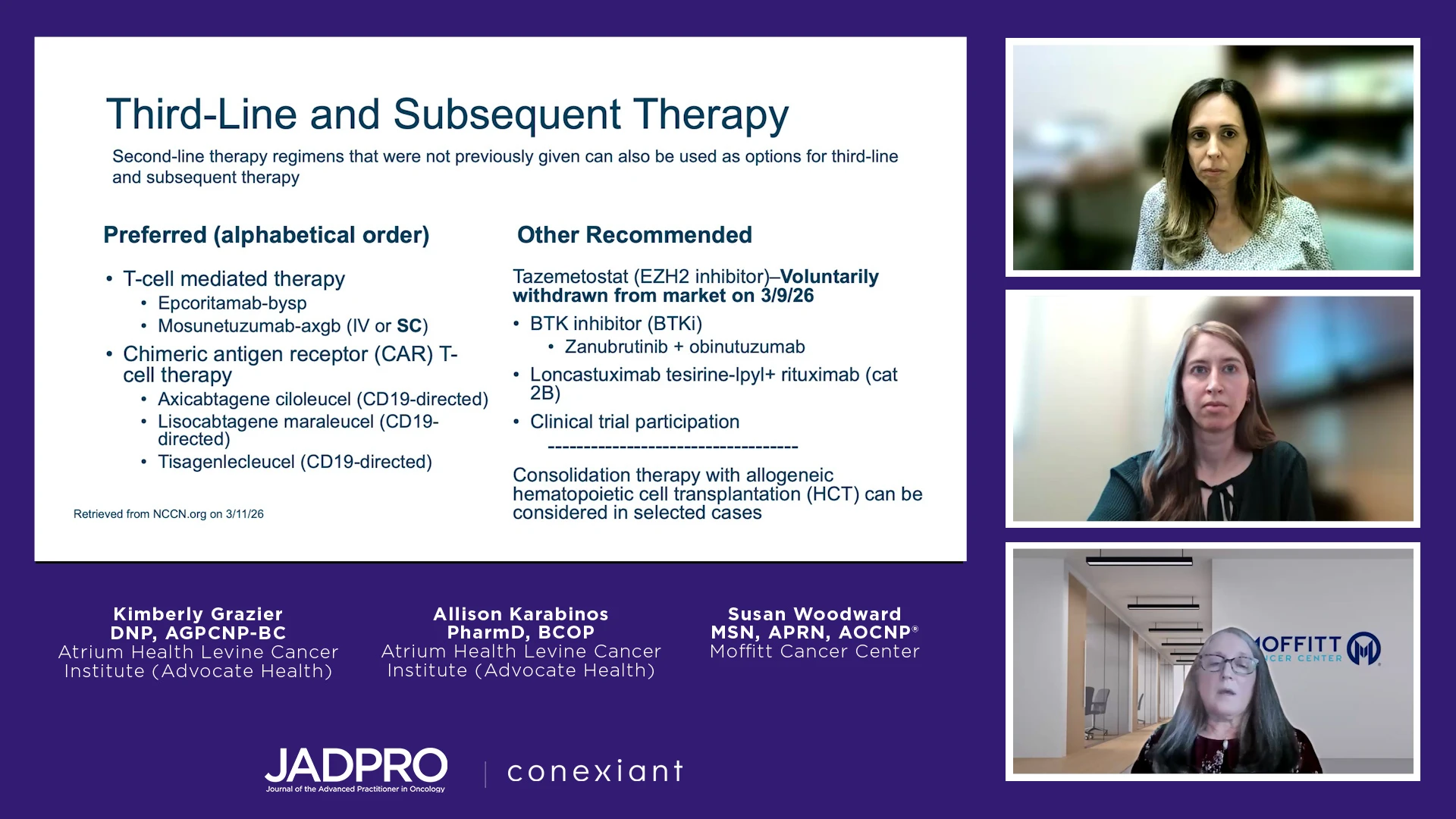
I think with both EPCOR-FL1 and then the inMIND study as well, both the median follow-up was only 14 months with their results reported in a 12-cycle regimen that goes about 12 months. Definitely some patients are still on active treatment, so just something to consider there. Then another thing we don't have a lot of information on or definitive answers, I wrote down eligibility for CAR T-cell therapy, knowing that our commercially available CAR-T agents are CD19-directed. I know at LCI, our preference is to avoid CD19 targeted agents if the plan is potentially for patients to move on to CAR T-cell therapy.
Susan Woodward:
Right, and again, there's some jury out on that still. We still don't have the best answer for that, for sure. I know studies are ongoing looking at that to see how likely are they to lose their CD19 expression when you're thinking that they may need CAR-T down the line.
Allison Carabinos:
Yes, we absolutely need more answers on that and hopefully will have them soon.
This last table, I just wrote a practical comparison just thinking about some of the things we've already discussed. But does anything stand out to you in relation to just some of the more operational things related to these regimens?
Susan Woodward:
Yes, again, the logistics, where they're going to be able to receive their treatment. Depending if they go the bispecific route already, you have logistical things that have to be dealt with in terms of where can they receive the therapy. Definitely when you get down to infection prophylaxis, it's so important that they take their infection prophylaxis. Also, for these patients we often have to keep a close monitoring of their IgG levels and consider using IVIG. At this point, with bispecifics in particular, I'm not waiting for them to get serious infections before I implement IVIG. I'm tending to be very liberal with it if the IgG levels are appropriately low and just getting the people who are on bispecific antibodies, getting them started on IVIG.
Kim Grazier:
One thing I've started to notice about the evolving landscape of bispecifics is we're starting to see more fixed durations with them, which I think makes it more appealing to patients and certainly easier to present the option when we're talking about options with patients.
Allison Carabinos:
Well, thank you, I think those are both great points. Really, for this practical comparison, again, just highlighting that patient education piece, I think, and choosing the right patient who can promptly recognize CRS and quickly seek medical attention as well if needed.
Kim Grazier:
This brings us to the end of this discussion. Please see our two other videos for further discussion on diagnosis, management, and the evolving treatment options of follicular lymphoma at jadpro.com.