

What Advanced Practitioners Need to Know About Management Strategies in Advanced EGFR-Positive NSCLC
Video 1: Taking a Long-Term View of Treatment Planning in Advanced EGFR-Positive NSCLC
In the first video of this series, Elizabeth Dennis MSN, APRN, FNP-C, Chaely Medley, MSN, AGNP, and Megan Van Volkenburg, PA-C, discuss factors involved in treatment selection and long-term planning, such as disease burden, potential for metastasis, performance status, and patient goals and preferences.
Chair
Elizabeth Dennis MSN, APRN, FNP-C
Texas Oncology
Faculty

Chaely Medley, MSN, AGNP
Novant Health Cancer Institute–Forsyth

Megan Van Volkenburg, PA-C
Atrium Health, Levine Cancer Institute
Transcript
Elizabeth Dennis:
Hi, and welcome to What Advanced Practitioners Need to Know About Management Strategies in Advanced EGFR-Positive Non–Small Cell Lung Cancer, a JADPRO Virtual Roundtable. My name is Elizabeth Dennis. I'm a nurse practitioner here at Texas Oncology, Baylor Dallas Sammons. Joining me today are two of my colleagues.
Megan Van Volkenburg:
Hi, I'm Megan Van Volkenburg. I am a hematology oncology physician assistant at Atrium Health Levine Cancer Institute in Charlotte, North Carolina. I work out of our infusion suite and with phase I clinical trial patients.
Chaely Medley:
Hi, my name is Chaely Medley. I'm a nurse practitioner. I'm working in thoracic oncology at Novant Cancer Institute in Winston-Salem, North Carolina.
Elizabeth Dennis:
Thank you, ladies. And this is a part one of a three-part series of managing advanced EGFR-positive non–small cell lung cancer. This first video will focus on selecting frontline therapies and establishing long-term treatment strategies to optimize outcomes for our patients.
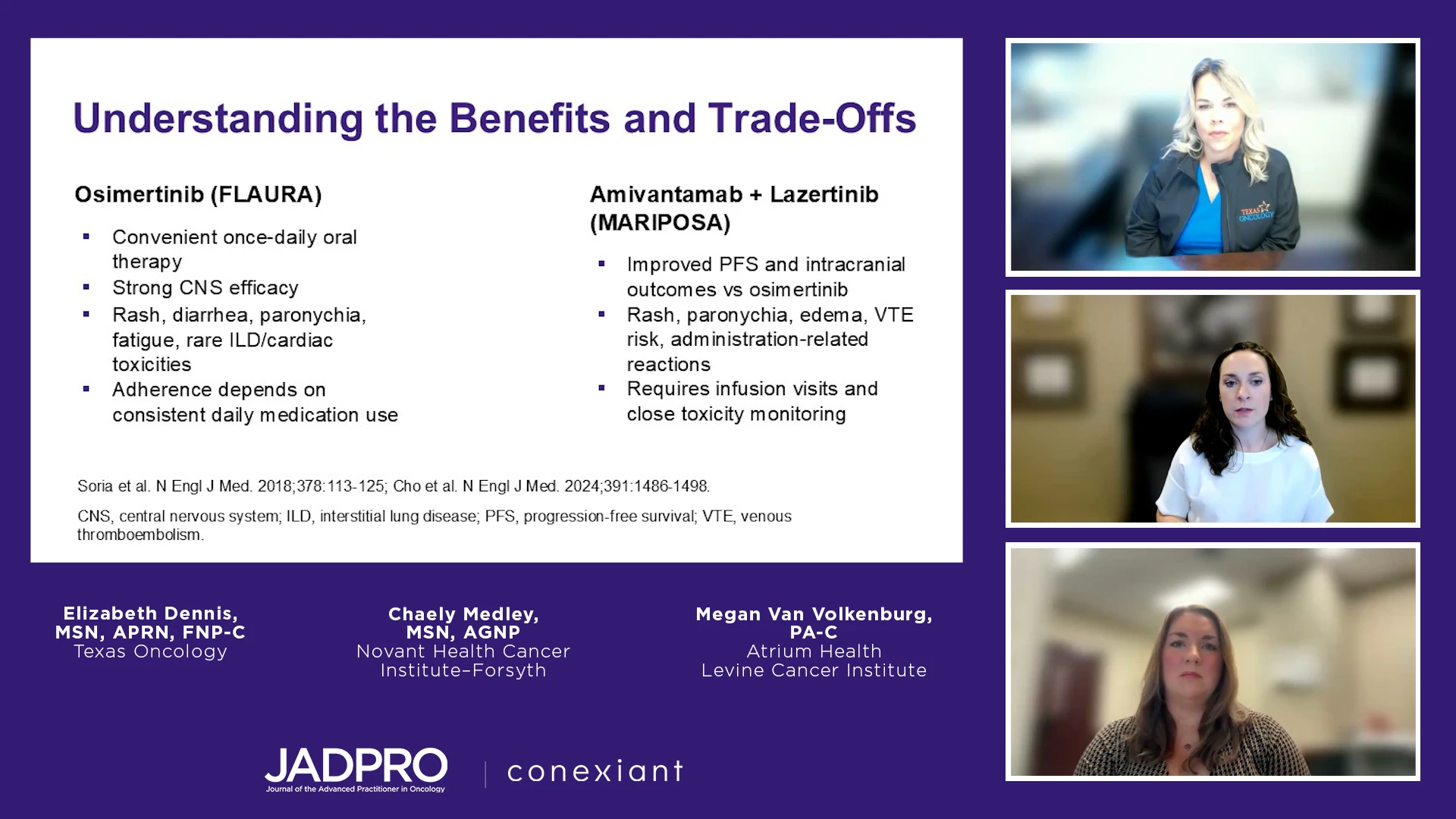
As we begin, we'll talk about the current frontline treatment options. Osimertinib, also the FLAURA trial, had a median PFS of 18.9 months, and a median overall survival of 38.6 months. It showed a strong CNS penetration and favorable tolerability. It has convenient once-daily oral dosing for our patients.
And then we have amivantamab and lazertinib from the MARIPOSA trial that had a median PFS of 23.7 months vs 16.6 months, with a 30% reduction in the risk of progression or death. It had improved intercranial outcomes as well as delayed resistance emergence and dual EGFR and MET targeting approaches. Chaely, when discussing frontline treatment options with a newly diagnosed patient with EGFR-mutated advanced non–small cell lung cancer, how do you balance the improved progression-free survival seen with amivantamab plus lazertinib against the convenience, tolerability, and long-term familiarity with osimertinib? And what specific factors most influence your recommendations?
Chaely Medley:
So, with most of our treatments, we're always balancing tolerability with efficacy. Amivantamab plus lazertinib does show that obviously it's very impressive with the progression-free survival, but it is quite toxic because we're targeting two EGFR targets plus the MET. So, really this is going to be a patient who has really heavy disease burden, probably some kind of L858R point mutation or TP53 mutation that's going to suggest they have really aggressive disease. And it's going to have to be a patient that can tolerate some of the skin and nail toxicities. There's a regimen called the COCOON regimen that's recommended that really requires patients to soak their nails, scrub their scalp, put creams on.
And they're also going to have to be able to take DVT prophylaxis for the first 4 months, which can be pretty cost-prohibitive for a lot of our patients. So, really it's got to be somebody who's pretty sick with their disease and really motivated and able to keep up with some of the complexities of the treatment. Osimertinib is kind of tried and true, once daily. We have a really good handle on some of the toxicities that we can see with these patients. Of course, we see the EGFR toxicities with skin and nail irritation, diarrhea, things like that, but they're not quite as severe because we're not targeting them double time like we are with the amivantamab plus lazertinib.
And we can always dose reduce pretty easily by dropping the patient to a 40-mg tablet or every other day, something along those lines. So, this would be a patient who maybe is more frail, elderly, maybe they're not interested in an extreme regimen that's going to cause severe toxicities. And they're not going to have one of these more complicated mutations that we'll see with the L858R. They're just going to be exon 19 deletion, pretty straightforward patient.
Elizabeth Dennis:
I agree. Osimertinib definitely has convenient once-day therapy. It's easy to adjust the dosing as needed. And with amivantamab plus lazertinib, you definitely have to utilize this in a patient who has availability of maybe a caregiver or someone that can help make sure that they're adherent to the COCOON regimen that they meet to help prevent those side effects. And then again, I agree, we're going to move forward into the next slide and discuss that does have a dual inhibitor approach to the EGFR and MET. And so, we may utilize this in a patient with brain metastases, another L858R like you were discussing.
So, continuing as we discussed on those current frontline treatment options, subcutaneous amivantamab plus lazertinib in the PALOMA-3 trial had a comparable efficacy to intravenous amivantamab, 13% administration-related reactions vs 66% with IV. So, we had a significant reduction in adverse reactions with the subcutaneous formulation. Administrative time was reduced, therefore we did increase the availability of chair time in the chemo room, as well as potential improvement in adherence, patient convenience, and just overall infusion center efficiency. With osimertinib plus chemotherapy in the FLAURA2 trial, we saw a median PFS of 29.5 months vs 19.9 months, and a median overall survival of 47.5 months vs 37.6 months.
We definitely consider this as we discussed in the previous slide with patients with higher-risk disease, TP53 co-mutation, L858R mutation, brain metastases, liver metastases, as well as high disease burden. And you can look at subcutaneous amivantamab plus lazertinib that way, as well. However, in my clinic, I see a lot of patients have this aversion to chemotherapy and don't want to receive chemotherapy. It's really important as us as nurse practitioners that we educate these patients that chemotherapy doesn't always mean toxic, that you can manage these side effects effectively with preventative measures.
So, Chaely, with the availability of subcutaneous amivantamab plus lazertinib and the encouraging efficacy of osimertinib plus chemotherapy in the FLAURA2 trial, how are you individualizing frontline treatment selection for patients with EGFR-mutated non-small cell lung cancer?
Chaely Medley:
So, the subcutaneous formulation of amivantamab still carries similar side effects to the IV formulation of amivantamab. And just to compare apples to apples here, 80% of patients had a grade 3 or greater adverse event in the amivantamab plus lazertinib group compared to 70% in the osimertinib plus chemotherapy group. So, pretty similar there. And what it really comes down to is does the patient want to or can they deal with skin toxicity, nail toxicity, the DVT prophylaxis that occurs or that we have to do to. There's a 40% chance that the patients will have a blood clot while they're on amivantamab plus lazertinib. So, it's pretty significant and not really something we would just say don't need to do it.
Or can they tolerate the chemotherapy side effects? You're right, Elizabeth, in saying that a lot of our patients don't want to do chemotherapy. And I think it's because patients really associate chemotherapy with being sick and having cancer. You're losing your hair, you're vomiting, you're having a lot of GI toxicity, you don't want to get out of bed. And so, patients would like to avoid that at all costs. But really what it comes down to is they're fairly similar. They have different ways that they're working, but with different types of drugs. And what are the toxicities that the patient can really tolerate? How often can they be in the clinic? And who is their support person?
What do they need to be available to do? Maybe the lethargy and the fatigue that come with chemotherapy isn't going to work for a younger patient who has a family and a job and things that they have to actually get out of the house and do. Whereas for an elderly patient who doesn't have those responsibilities, they might be better able to tolerate chemotherapy than they would some of the toxicities of amivantamab plus lazertinib. So, it just comes down to talking to your patient. How about you? What do you think?
Elizabeth Dennis:
I agree. Individualizing care is super important, and we as the nurse practitioners and providers need to be sure that these patients are educated. A lot of these patients are non-smokers and younger, so they need to be educated on what preventative measures they would need to use with amivantamab plus lazertinib vs osimertinib plus chemotherapy and ensure that they can be adherent to those. And Megan, you work in the infusion room, so the subcutaneous formulation of amivantamab has significantly reduced administrative related reactions and infusion time compared with IV amivantamab.
How has that changed your approach to patient education, toxicity monitoring, and just workflow within your infusion center? And what impact may have you seen on patient satisfaction and treatment adherence?
Megan Van Volkenburg:
So, such a win to have that subcutaneous formulation available now for the appropriate patient. Certainly the reduced infusion times. Previously with the IV formulation of amivantamab, we were having patients, they could only have really an 8:00 AM start time infusion. We were really on the clock. I think they probably felt our stress within the infusion center of having to really stay on top of all the timelines as quickly as we could to make sure that we could get their full duration of therapy and the observation period in, especially on those first 1 to 2 days when we expected the reactions to the IV amivantamab.
So, obviously we're still seeing the IV and amivantamab given, but now with the subcutaneous formulation, there's still the chance of reactions, although it's greatly decreased. I think the dosing of the steroids 2 days prior has really, we have seen reduced reactions in both the IV and the subcutaneous formulation with that steroid beforehand. So, I think that was a huge improvement as well. And I think that has increased just buy-in from patients and their care team, their family at home, their friends, whoever's going to be helping them that we can come here, you're still going to have not a short infusion day, but it's significantly shorter compared to the IV formulation.
We still have to go over obviously the toxicities and the side effects that can happen while they're in the infusion center as far as reactions or intolerances. And then also after they leave, those side effects and risks like we talked about are similar from that standpoint. So, we're still being very diligent with doing our part to reeducate, reinforce what they can do at home to maximize their care, prevent side effects so that they can stay on therapy for as long as possible. But I think just like we said, the overall adherence and agreeability and mindset with the subcutaneous option has certainly been a win that we've seen.
And as far as our flow within the infusion center, we're able to offer patients different start times, which can help with just their schedule and feeling like they have some ownership over their care. So, instead of saying you have to be here by 8:00 AM on the dot for us to get your full care in, we can be a little bit more relaxed with that, still keeping in mind that observation period after and leaving time for any potential reactions or side effects. We have time to manage that.
And I think just overall as practitioners and nurses, the stress level has gone down a little bit as we know that when we look at our day and all the patients we're going to care for, we may not be tied up with those amivantamab patients as much as we were in the past now that the subcutaneous version is available.
Elizabeth Dennis:
Thank you. I agree. So, also for patients, we need to be offering clinical trials. So, that should be considered at diagnosis and at progression to maximize long-term treatment options. Factors influencing first-line selection as we discussed could be disease burden, metastatic sites, including CNS involvement, symptomatic vs asymptomatic disease. As Chaely talked about earlier, performance status and comorbidities are super important. Toxicity profile, future treatment sequencing, and patient preferences and goals of care. These are all important to include when discussing frontline treatment options with our patients.
So, Chaely, how does disease burden, CNS metastasis and patient goals influence your first-line treatment options?
Chaely Medley:
So, I think first and foremost, the patient goals are always going to be the big driver. I educate my patients. My job is not to tell you what to do. My job is to give you the tools to help you decide what you need to do. So, I want their goals to be the driving factor to the decisions that we make. Part of that usually includes how symptomatic are they? What is the level of disease burden? CNS metastases, we know that these patients as EGFR-positive patients will very, very commonly have brain metastases oftentimes at diagnosis or sometime during their treatment trajectory.
I think either of these regimens really are good for that, but it's just going to come down to what are the big toxicities? What are the other mutations or co-mutations that we're seeing with their disease presentation? And what does this treatment look like for the patient?
Elizabeth Dennis:
I agree. Symptomatic vs asymptomatic disease is a big driver in clinic, as you know. We may be more aggressive with the amivantamab plus lazertinib version if we see a very symptomatic patient to get a quick response vs single-agent osimertinib alone. But osimertinib with chemotherapy has great options for patients and has a great toxicity profile, meaning that we are able to manage it in clinic very well. We're very comfortable with it, and we can dose reduce easily and help some of those toxicities to prevent patient from coming off treatment, which decreases a lot of patient anxiety. So, Megan, how do you help patients manage toxicities and stay adherent to frontline EGFR-directed therapy?
Megan Van Volkenburg:
So, I think the proactive management that clinic does in the forefront before they even reach the infusion center is so helpful for patients and for us as the infusion providers. So, patients generally are really well-educated before they even come to us as far as what their home care will look like. They already have their kit at home as far as their prescription and non-prescription medicines that will help to try to ward off side effects and toxicities so that they can stay on therapy. There is sometime a little bit of an element of some of the topicals and the skincare is just an extra step for people that may not have been part of their routine in the past.
And while it's not necessarily causing side effects that they wouldn't like from those additional care, it's just another step in their routine that they hadn't planned for before. We're seeing more young patients, we're also seeing men more commonly needing to be on this treatment. And skincare may not have typically looked like lotions and topicals for them before. It may have just been whatever soaps in the shower. So, getting that pattern recognition in their system of saying, "I know that these are going to be changes. We're going to be going through a lot," and just trying to show them compassion and just reinforce that importance of if we take these steps, if we can make this a part of your daily routine, we have seen the data to show that it really can help to decrease your toxicities and ultimately be able to keep you on therapy without delays or holds. So, I think just that early education is really key, and then we can help reinforce that in the infusion setting.
Elizabeth Dennis:
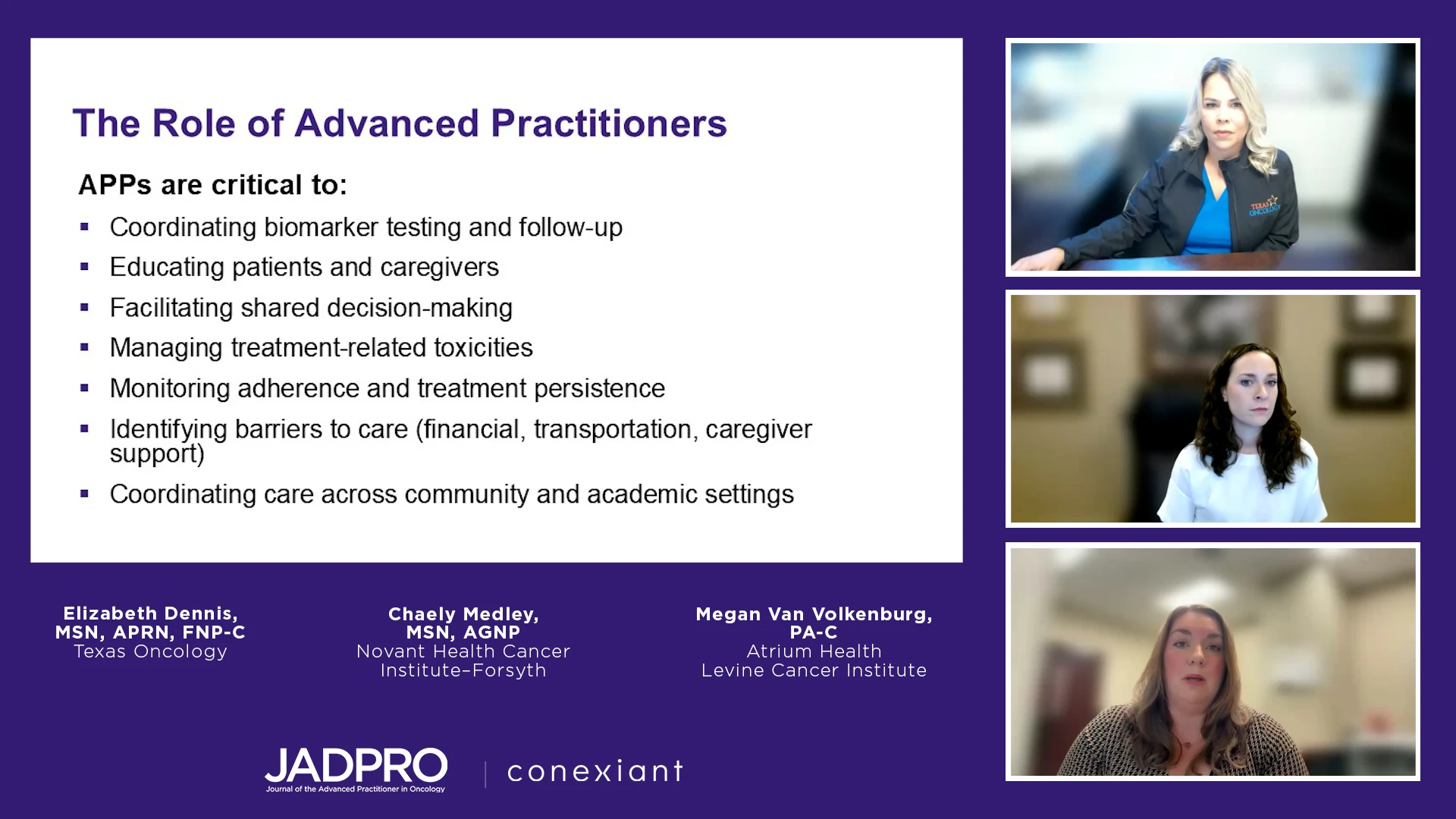
I agree, Megan. Compliance and patient adherence considerations. We need to evaluate the ability to adhere to daily oral therapy and/or infusion schedules, assess patients' transportation, their caregiver support, their work obligations like Chaely mentioned, financial barriers, prophylactic management of rash and the nails, as well as infusion-related reactions, their cytopenias they may experience, VTEs, GI toxicities like diarrhea to reduce treatment interruption. So, education is super important in these patients, and it starts with us as the provider and goes down to the nurses in clinic as well as the nurses giving in the infusion in the infusion room and the APP infusion providers.
So, we need to use shared decision-making to align treatment intensity with patient goals and optimize adherence to maximizing long-term clinical benefit. So, long-term strategies should be maximizing depth and duration of response upfront, preserve CNS control throughout the disease course, and plan for repeat liquid and/or tissue biopsy at progression. We need to anticipate resistant mechanisms and future target options for our patients, as well as reassess their goals as time goes on and at every treatment transition. Do you ladies have anything else to add?
Chaely Medley:
No, I think it's a good thing to have so many different options to offer our patients and be able to tailor it specifically to the patient instead of just saying one size fits all, this is what we got, and then just have to roll with that. So, this is complicated things, but in the best way.
Elizabeth Dennis:
I agree. So, this brings us to the end of our video. Please see our two other videos for further discussion about management strategies in advanced EGFR-positive non-small cell at jadpro.com.
Elizabeth Dennis:
I agree. So, this brings us to the end of our video. Please see our two other videos for further discussion about management strategies in advanced EGFR-positive non-small cell at jadpro.com.