

Shared Decisions, Better Outcome: Collaboration in Managing Targeted Therapy for HR-Positive/HER2-Negative Breast Cancer
Promoting Adherence Through Early Management Strategies
Erika Hamilton, MD, Heather Moore, CPP, PharmD, and Melissa Rikal, MSN, FNP-BC, AOCNP®, discuss multidisciplinary strategies for managing targeted therapy in hormone receptor-positive breast cancer. Emphasizing proactive toxicity management, patient education, and frequent monitoring to improve adherence, they also stressed that effective communication regarding potential side effects and dose reductions helped produce long-term treatment success.
Chair

Erika Hamilton, MD
Sarah Cannon Research Institute
Faculty
Melissa Rikal, MSN, FNP-BC, AOCNP®
SCRI Oncology Partners
Heather Moore, CPP, PharmD
Duke Cancer Institute
Transcript
Dr. Erika Hamilton: Welcome to Shared Decisions, Better Outcome: Collaboration in Managing Targeted Therapy for Hormone Receptor-Positive/HER2-negative Breast Cancer, a JADPRO Virtual Roundtable. I'm Dr. Erica Hamilton, Chief Development Officer at Late Phase and Director of the Breast Cancer Research Program at Sarah Cannon Research Institute in Nashville, Tennessee. I’m joined by two fantastic colleagues today, and I'll let them introduce themselves. Heather, why don't you go first?
Heather Moore: Hi, my name is Heather Moore. I'm a clinical oncology pharmacist and breast oncology at the Duke Cancer Institute, where I've been in breast oncology for about 8 years now.
Dr. Erika Hamilton: Thanks so much for joining us, Heather. And Melissa?
Melissa Rikal: I'm Melissa Rikal. I'm a nurse practitioner at Sarah Cannon Research Institute. I've been here for about 12 years now, primarily working with breast and gynecologic cancer patients in our research space.
Dr. Erika Hamilton: Fantastic! Now that we've done introductions, this is part two of our three-part series on team-based care and breast cancer. Melissa is going to present this second case for us, which will focus on early management strategies that support adherence and minimize early discontinuations in breast cancer. Melissa, why don't you take it away?
Melissa Rikal: Okay. So, starting with case two, this is an actual case of one of our patients we've had here in clinic. MB is a 62-year-old African American female. She was diagnosed at age 57 and at the time had a pretty large 12.4-cm invasive lobular carcinoma, Grade 2. She did have a sentinel node that was positive, and it was strongly ER/PR positive, 100% ER and PR 100%. And her HER2 IHC was 1+, so it did not reflex to FISH. Her baseline staging–it did actually look like she had an enlarged peritracheal node, but biopsy ended up showing that was negative, so we treated her with curative intent therapy. She received adjuvant therapy with just endocrine therapy, actually. Her MammaPrint was low-risk, so we did not pursue chemotherapy. She was on letrozole for 6 months, had pretty bad hot flashes and arthralgias, so stopped this. We tried exemestane for 3 months, also did not tolerate with arthralgias.
At that point, she did not want to pursue any further adjuvant endocrine therapy, so we just monitored her on surveillance. She comes in 6 months later with some chest wall pain, and we do a CT scan, which shows diffuse bone metastases involving her sternum as well, which caused the chest wall pain, as well as axillary adenopathy. We do a bone biopsy, and this does show metastatic adenocarcinoma consistent with breast primary. She's still ER positive 100%, PR 80%, and we're not able to get a HER2 result due to it being bone. We also do NGS testing with a liquid biopsy just to see where she is at baseline, and she has a PIK3CA mutation at TP53 and is MSS. So she goes on for first-line treatment on a clinical trial actually in our clinic. So she's on palbociclib, fulvestrant, and capivasertib.
She also is on zoledronic acid for the bone involvement. We do that every 28 days. We notice some key risks for non-adherence with MB. She has prior AI intolerance, so therefore some potential anxiety about side effects and also has just potential for symptom burden with GI toxicity cytopenias and the risk of hyperglycemia on capivasertib as well as palbo. What are some strategies that the provider team could implement to promote adherence prior to treatment initiation? Erika, any thoughts?
Dr. Erika Hamilton: I think a lot of this comes down to communication. Making sure that patients feel like the communication is open to talk about their side effects, that you want to work with them about side effects, what they should expect and what they shouldn't expect. Also, the possibility of dose reductions if patients don't tolerate something well, I think sometimes that's helpful in preventing patients from just quitting cold turkey and not trying. And then other things that we can do to manage these side effects. So I think really setting expectations and setting expectations about how we're going to work with the patient to manage the side effects could be helpful.
Melissa Rikal: I agree. I think just helping them know that we really want them to be on this long-term and that there are options if they don't tolerate this, so they don't think they're just stuck. Dose reduction, better symptom management, that sort of thing. I also think we have a little bit of unique dosing here with palbociclib being 3 weeks on, 1 week off, and capivasertib having the 4 days on, 3 days off dosing. So I think really nailing that down with the patient in advance helps them see how this is going to play out and have a little bit of a plan on how to take their treatments. Heather, do you have any other thoughts?
Heather Moore: Yes, I would completely agree with what Erika mentioned earlier in terms of just being very transparent with patients. I find it very helpful too when you're discussing side effects, providing more definitions, quantification in terms of when we think about diarrhea, well, how much diarrhea? And at what point would I take this? And how would I manage that? I think it's really helpful for them. I think with a lot of our therapies, as mentioned, we do have relative dose intensity data, so it's helpful to let them know that within many of our clinical trials, we know that dose reduction doesn't necessarily impact efficacy. I think also knowing that very often within our trials, that patients often require dose reductions or dose holds. And that kind of like you alluded to, that it's really the long game in terms of making sure that we're staying on therapy and that patients are adhering over time.
I think as you mentioned, I can envision that the palbociclib being 3 weeks on and 1 week off and concurrent with capi, 4 on, 3 off could be quite challenging. I often find it helpful to visualize and provide calendars for patients in that situation so that they can, whether they are setting it in their calendars or their phone alarms or putting it on their refrigerators, but they can visualize how they're taking their therapies, and that tends to help them sometimes.
Melissa Rikal: Moving on for MB, let's look at her comorbidities that she has going on to this triplet therapy. She has hypertension and takes carvedilol. Anorexia as actually a baseline symptom. So we've been actually talking to her about focusing on high protein meals, incorporating liquid supplements. She also has some pain related to her bone involvement. We now have a palliative care NP helping with this, and she's on hydromorphone 1-mg PRN. She also has some nausea, which we think is secondary to her opioid use, and she uses PRN prochlorperazine and olanzapine, and fatigue as well, which is just multifactorial due to malignancy, some depression related to her diagnosis and progression of disease and malnutrition at baseline as well. Her hemoglobin is pretty secure at baseline at 11.5. She does have some constipation as well, also related to her opioid use. She uses senna BID and polyethylene glycol PRN.
Her baseline fasting glucose is 112. Her hemoglobin A1C is 5.8%, so she's kind of in that pre-diabetic range. Again, CBC is within normal range at baseline. What, if any, comorbidities or baseline symptoms would be of a concern in a patient starting this targeted therapy? Anything we see for MB or generally with other patients going on to these type of therapies that would be of concern to you all? Heather, any thoughts?
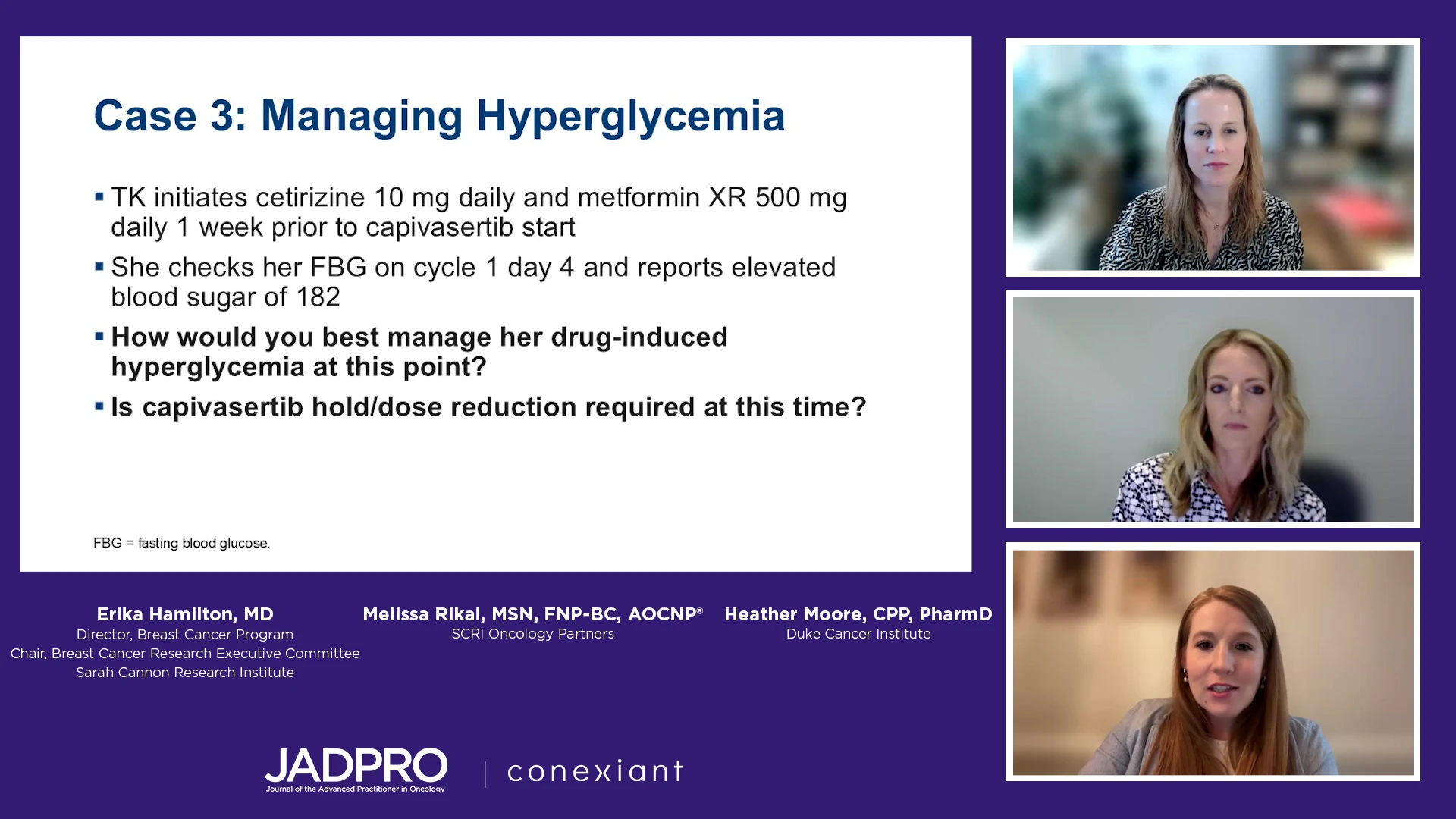
Heather Moore: Yes, so the pre-diabetes is something that I would want to especially be mindful of. We know with this class of agents, in terms of PI3K inhibitors, AKT inhibitors, that these patients are at a much higher risk of hyperglycemia. Thinking about risk factors like A1C, fasting blood glucose, BMI, or age that can be contributory. And we'll talk about this a little bit more with case 3, but in my opinion, mitigation is really what's so important here to help with preventing toxicity later. So if you can identify those high-risk patients and mitigate toxicity, that's something that could be helpful. So for her, because her A1C is within that pre-diabetic range, and that is something that with CAPItello-291, there was a safety event analysis that showed that for those patients considering prophylaxis, we can also extrapolate from some of our other data with METALLICA and previous retrospective studies, the concept of prophylaxis. This is someone that I would certainly think about prophylaxing with an anti-hyperglycemic to try to help prevent hyperglycemia, given her known risk factor.
Melissa Rikal: Erika, anything else that jumps out to you in regard to comorbidities we would be thinking about?
Dr. Erika Hamilton: Yes, I agree with Heather. And in general, this class we think about hyperglycemia, rash, and diarrhea as the big three. Now compared to alpelisib, our PI3, we do get less hyperglycemia with capivasertib, but we still get rash and we still get diarrhea. So in some ways, looking at her baseline side effects, I'm a little bit glad that she has constipation because if we give her some diarrhea, we might equal out and she might be a little bit of a happier camper or at least not have as much diarrhea as we would typically think. But I think fatigue is probably going to be an issue with her. We tend to see that with our targeted agents, and she already has some fatigue at baseline and maybe just GI side effects, the nausea, the anorexia, etc. So those are things that I'm probably going to pay a close attention to in her.
Melissa Rikal: And then any other ways the provider team can be proactive to promote tolerance in a patient starting targeted therapies with multiple comorbidities? I know we kind of had this question earlier, but more specifically thinking about comorbidities. I guess in my mind, I'm thinking about if we're concerned about her prediabetes and we know there's a risk of hyperglycemia with capivasertib, maybe we think about sending her to a specialist, endocrinology, go ahead and get that ball rolling. I know depending on proximity to specialists and such, it can take a little while to get patients in. And so maybe going ahead and sending that referral to get the ball rolling, knowing that she's starting this. Any other thoughts from Heather or Erika?
Heather Moore: Yes, I think one other thing that I would mention would just be often in this setting, again, extrapolating from some of the other drugs we've seen in this class and know with rash that thinking about H1 prophylaxis with antihistamine sometimes can be helpful. So maybe worth starting her on cetirizine or another H1 blocker prior to start or around start time just for rash prevention as we have seen that, that can reduce higher grade rash.
Melissa Rikal: Okay. Moving on, MB comes in for cycle 1, day 1 of capivasertib, palbociclib, and fulvestrant on her clinical trial. For these targeted therapies, how would we commonly set expectations for symptom monitoring, including timelines, communication pathways and team roles? I can go ahead and start it off. I think most importantly, like we already talked about is giving them a dosing diary. A lot of times our new patient packets that come in for these oral oncolytics have a dosing diary with them. And so laying at that timeline, not just dosing though, but coming in for frequent blood draws. So normally we're checking their glucose weekly or at least every 2 weeks in that first cycle or so. The fulvestrant is given at that 2-week mark in the beginning, so they're coming in anyway for that. And so going through the timeline of glucose monitoring, also neutrophil monitoring with palbo Q2 weeks for the first couple cycles. And so kind of laying that out. And then what other things will we talk to the patients about as far as maybe team roles or communication pathways, Heather?
Heather Moore: So with this class of agents, we often provide glucometers, test strips, lancets, so that patients are aware because they are checking their blood sugars on day 3 or 4, almost every week with cycle 1 and then mid-cycle. So on the days where they're not having lab checks, if we can't align lab checks to be fasting. And so we find it really helpful to utilize our EMR in terms of having patients message in, or this is also where our nursing team can be really helpful in calling patients for follow-up. I touch base with all of our patients on the day 4 of their weeks of their glucose checks because that way I can real-time make changes to their antihyperglycemic regimen or add something on if needed. So I think it really is a team effort with the toxicities that we see with these regimens.
So aside from, like you mentioned, follow-up visits when they're getting actual labs drawn, touchpoints through each week. And I think we find that that first cycle, and what I educate patients about is really the most challenging and the more intensive in terms of monitoring. So just having a lot of touchpoints to discuss hyperglycemia, rash, diarrhea. So again, I think it's just a team effort to ensure that patients are tolerating well and that we're able to maintain them.
Melissa Rikal: And I think, like you said, setting the stage with the patient that the first cycle or two are going to be a little bit more intensive monitoring, it's not going to be like this long-term. Hang in there, get through this first cycle or two, and then your visits are going to space out a ton, but we normally are seeing these AEs present in that first cycle or two, so they're coming in a lot more frequently then. Erika, any other thoughts?
Dr. Erika Hamilton: No, I agree. I think it's the expectation that things may not feel great on a new medication until we work out what that individual patient needs, but that things will get better. So setting that expectation can be really helpful for patients.
Melissa Rikal: And then Heather touched on this earlier, but thinking about proactive management of some of the common AEs that we see with this therapy, I know Heather mentioned with the rash, we would think about maybe using some prophylactic antihistamines, particularly the non-drowsy ones. And do you all have other thoughts? Erika, any thoughts about other prophylactic or proactive management of the other AEs we see?
Dr. Erika Hamilton: Yes, you're definitely going to want to make sure that the patient has something like loperamide available at home. If somebody has diarrhea, having them try to drive to the store to get loperamide is not ideal. So I definitely make sure that patients have loperamide at home and are educated about how to use that where they're not waiting until the next business day to call the clinic to try to get instructions. So making sure that they're educated about that upfront is another big one.
Melissa Rikal: Heather, any thoughts about the other AEs and some ways we can be proactive?
Heather Moore: I think sometimes, I mean, mucositis is something that we can sometimes see. So I think for patients that may be at higher risk, lower threshold in terms of thinking about dex mouthwash for some of those patients, extrapolating from what we know from the SWISH study and integrating some of that. Otherwise, identifying those high risk factors for hyperglycemia rash like we talked about.
Melissa Rikal: The other thing I think about with the neutropenia is just setting the stage for the patient that this neutropenia doesn't necessarily translate to infection, but we do need to know if you have any signs and symptoms of fever over 100.4, bring you in, check your CBC, potentially hold treatment if you have a fever and are also neutropenic at that point. But because of the way the neutropenia occurs with CDK4/6 inhibitors, just helping that fear factor of, this doesn't have the cytotoxic effect of chemotherapy. So it's essentially just pausing those neutrophils in their DNA replication. Once we hold the therapy, neutrophils rebound pretty quickly, but just talking through that with the patient in advance on palbociclib as well, I think is helpful.
Okay. Moving on with this case–MB returns for cycle 1 day 15. She has four episodes a day of Grade 1 diarrhea for 4 days now. It's actually now resolved that she's come in to see us because she utilized loperamide as we discussed with her and has actually ended up causing constipation, which was a baseline issue for her. So she reports feeling dehydrated, some trouble with fluid intake due to dysgeusia and reports water tastes funny. We noticed some lab alterations with a low ANC of 680 and a high glucose of 175. So our plan is actually to utilize loperamide PRN when she's leaving the house or if she has diarrhea more than three episodes in 24 hours in order to avoid constipation. So we kind of make a little bit more of a unique plan for her diarrhea because it's so quickly transitioned to constipation.
We also reinforce the importance of hydration, especially since she has anorexia at baseline, some nausea and now new-onset diarrhea. We give her a liter of normal saline in the clinic and encourage some water additives to improve her taste. We hold her palbo since her ANC is less than 1,000, and we say it's okay to continue the capi and fulvestrant per protocol. Return in a week for a CBC check. We start metformin at a thousand milligrams BID for her Grade 2 elevated glucose, and we have an upcoming endocrinologist appointment set up for her due to her prediabetes at baseline. So, she comes in for cycle 1 day 21. She reports recurrent diarrhea after starting metformin. We plan to change that to metformin ER since we've seen that the extended release version is much better tolerated from a diarrhea standpoint. Her ANC is a little bit better at 830, but still less than a thousand, so we continue to hold her palbociclib.
She comes in a week later for cycle 2 day 1. Her diarrhea is now nearly resolved. She only has 1-2 episodes a week with the metformin change we made and we talk through ongoing use of PRN loperamide. Fasting glucose is much better at 94 and her ANC is now recovered to 1,800. So we restart her palbo at a dose reduction since she had that prolonged neutropenia, so she'll go to 100 mg of the palbo. So, with ongoing tolerance for MB, she continues on this triplet first-line therapy on clinical trial for 28 months, so great response to first-line therapy. She has a good quality of life, good blood counts, great glucose control, and hemoglobin A1C, and minimal diarrhea due to prompt management of those AEs in her early cycles.
So, some key takeaways from this case–proactive toxicity management, managing that neutropenia, talking about expectations for that, that it's irreversible, when to call in with fever, etc., diarrhea with capivasertib. Very early on knowing what to have on hand, particularly loperamide at home and when to start that with your first episode of diarrhea, talking through hydration and dietary changes. There is a risk of stomatitis with this combination. So talking through prophylaxis for that with our sensitive toothpaste, toothbrush, alcohol-free mouthwash, talking about dietary changes like avoiding highly acidic foods. Rash, using prophylactic antihistamines and moisturizers at baseline, dermatology referral if they have a rash that's difficult to control. And then hyperglycemia, getting that glucose at baseline and considering early metformin use, particularly in those that are pre-diabetic or have that early hyperglycemia. Other key takeaways, just patient-centered education, really setting those expectations at baseline, talking through with the patients that side effects are common but manageable, addressing any prior barriers like this patient had from prior toxicity. So really talking through that and making her feel comfortable going onto this therapy.
And then early and frequent monitoring. In that first cycle or two, just that increased monitoring, setting the stage for the patient that they'll be coming in more frequently so we can make sure they tolerate this the best that they can and are on it for a good durable benefit. And then multidisciplinary support, so utilizing our triage team, maybe our patient portals for messaging about symptoms and visits, and then utilizing specialists when needed, such as palliative care, endocrinologists if they have hyperglycemia or dermatology, if they have that rash tox.
Dr. Erika Hamilton: Well, fantastic. Thank you, Melissa, for a great presentation. This brings us to the end of this case. Please see our other two videos for further discussion about the latest research in breast cancer at JADPRO.com.