Amber Koehler:
Welcome to this virtual roundtable about Navigating Second-Line-Plus Treatment in CLL: Sequencing Strategies, Guideline Alignment, and Real-World Patient Considerations. My name is Amber Koehler and I'm a PA at Mayo Clinic in Rochester, Minnesota. I'm very excited to be here today joined by my colleagues, Amy Goodrich, a nurse practitioner at the Johns Hopkins Kimmel Cancer Center in Baltimore, Maryland, as well as Mollie Moran, a nurse practitioner from James Cancer Hospital at The Ohio State University in Columbus, Ohio. Today, I'm going to get our discussion rolling about progression after frontline therapy in CLL.
The first thing we're going to talk about is principles of progression. So, evidence of progression in CLL does not automatically mean that we need to treat our patients. And it's very important that we rely on that 2018 iwCLL criteria to determine the need to institute second-line therapy. So we're looking for things like a hemoglobin of less than 10 g/dL attributable to CLL, not due to iron deficiency, B12 deficiency, etc., platelet count less than 100,000, large or symptomatic lymph nodes or a big spleen, B symptoms, fevers unexplained by an infection, drenching night sweats where they're soaking their sheets, needing to change their pajamas, losing weight without trying, severe fatigue not attributable to other causes. We would also consider treating for autoimmune cytopenias refractory to say that initial frontline corticosteroid therapy, and then a little bit of a gray area, but lymphocyte count doubling time of 6 months or less. Was there anything you would add to that, Amy or Mollie?
Amy Goodrich:
Those are the big ones, really. And then trying to educate patients to make sure they understand what we're looking for is really the most important part.
Mollie Moran:
I agree. We tend to tell patients that it's as when you needed your frontline therapy. These are a lot of the same criteria.
Amber Koehler:
Absolutely. I think that helps a lot. Especially when they've been through it before, it helps them understand what to watch for the second time around. A lot of times people will tell me, "Oh, Amber, I thought I was just getting old with fatigue." And then you treat them and they feel better and they realize, "Oh, okay, that was the CLL." So as we think about the current treatment landscape in CLL, it's a mouthful, right? There's a lot of words, there's a lot of acronyms. And so I just want to set the stage for the types of medications we're going to be talking about. Covalent BTK inhibitors are going to be things like ibrutinib, acalabrutinib, and zanubrutinib. Our non-covalent Bruton tyrosine kinase inhibitor that's approved is pirtobrutinib. We have our BCL-2 inhibitor, venetoclax, and then our anti-CD20 monoclonal antibodies.
The two that you'll hear most often in CLL, the most common one, is going to be your obinutuzumab followed by rituximab. Ofatumumab is one of those as well, but I know we haven't used that in several years. I don't know if you guys are still using that in your practice.
Amy Goodrich:
I'm not using it for CLL.
Amber Koehler:
Right. It's been a few years. Now, as we think about those buckets of frontline therapy, obviously today we're talking about second-line therapy and beyond. I think it's important that we recognize what types of treatments patients have had. Now, chemoimmunotherapy, people who have only had chemoimmunotherapy that are progressing, that bucket of patients seems to be less and less. I would say most of my patients who have had prior chemoimmunotherapy, things like BR, FCR, most of them have progressed already and are on subsequent lines of treatment. Has that been your experience?
Amy Goodrich:
Definitely.
Mollie Moran:
I would agree. The majority have progressed. There are those few outliers, and you think to yourself, "Boy, chemotherapy did work." But they're few and far between. It's truly that, you're right, Amber, most of them have progressed.
Amber Koehler:
Yes, but there is always a handful. So I think as we think today about the patients we're seeing in clinic who are progressing and need second-line or beyond treatment, most of them have now also seen a continuous covalent BTK inhibitor, things like the ibrutinib, zanubrutinib, acalabrutinib with or without one of those monoclonal anti-CD20s. Then we've got that bucket of people who maybe have been on a venetoclax plus obinutuzumab frontline regimen as was published in CLL-14. And then our third major bucket would be those individuals who are getting combo therapy, time-limited covalent BTK inhibitor, BCL-2 inhibitor, plus or minus some of those triplet therapy patients, also getting a monoclonal anti-CD20 antibody.
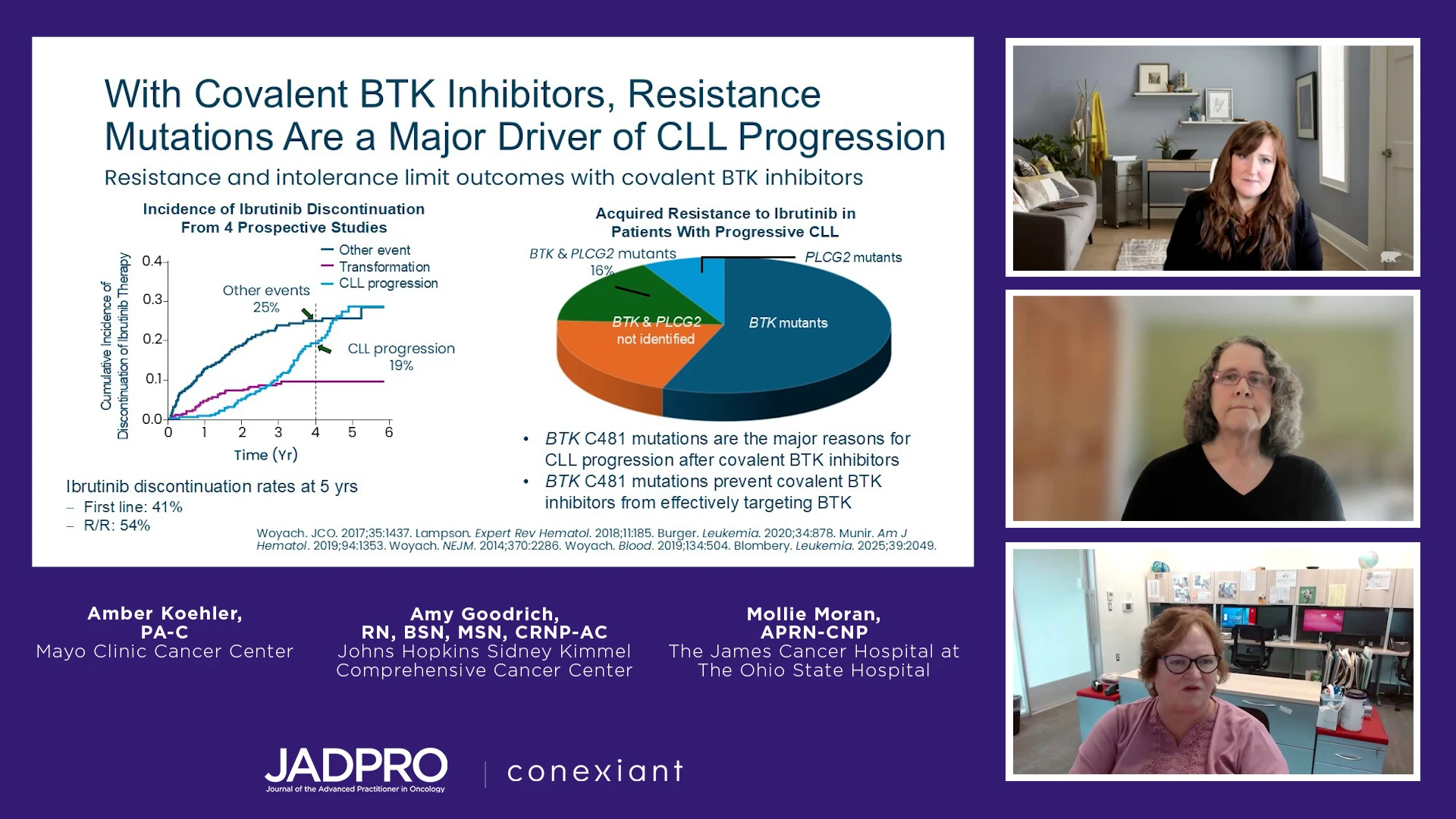
When we think about considerations for choice of second-line therapy, in addition to considering what they've received frontline, I think other things that we often think about are tolerability of frontline therapy. Did they have side effects? What side effects were they? Is there any evidence now of clonal evolution, particularly that deletion 17p or TP53, some of those bad actors in CLL? We'll talk about this more, but I think that presence or absence of resistance mutations are really important as we start looking ahead to additional lines of therapy. And then the classic comorbidities, logistics, patient preference. Does that capture what you guys think about? Or what are we missing when you're thinking about considerations for second-line therapy?
Amy Goodrich:
I think that's a good list of issues. Really patient preference is huge for choice of second-line therapy, but depending on some of those other bullet points, their preference may or may not be logical based on some of those things above their comorbidity, the logistics. Logistics play a big part of it as well, and that definitely weighs into patient preference too.
Mollie Moran:
I agree. I think it's a pretty good summary of what we put into the thought process of helping a patient get onto the second-line therapy.
Amber Koehler:
Now what's interesting as we look at the guidelines, one of the biggest changes I've seen in the past few years in the NCCN guidelines is in the second-line setting, there is no longer a stratification of recommendation based on presence or absence of deletion 17p or TP53 disruption. And so in that preferred category of regimens, you have venetoclax plus obinutuzumab. And that's different because we typically think about venetoclax plus obinutuzumab in the frontline setting with CLL-14, whereas venetoclax plus rituximab was that original relapsed setting, the MURANO trial. I would say that we have definitely in our practice done venetoclax plus obinutuzumab in the relapse setting much more than the venetoclax plus rituximab. Is that similar or are you guys still doing the MURANO regimen?
Amy Goodrich:
We're doing mainly CLL-14. And we do have some folks who are finishing up that two-year of venetoclax and rituximab, but we're really moving away from that as time goes on.
Mollie Moran:
I think we're leaning a little heavier into the obinutuzumab as well, plus venetoclax for the first six months.
Amber Koehler:
Those other preferred regimens in the second-line setting, we see the continuous covalent BTK inhibitors. Now, they do bucket these out in the regimen. So the preferred regimens of continuous covalent BTK inhibitors are acalabrutinib and zanubrutinib as category one recommendations. Ibrutinib is still included in the guidelines. It's just over in the other recommended regimens box. And then there is, under preferred regimens, a continuous non-covalent BTK inhibitor, so specifically a category one recommendation for pirtobrutinib. And there's a unique setting for that, meaning patients who have resistance to or intolerance to prior covalent BTK inhibitors, pirtobrutinib would be considered a preferred regimen.
So as we break that down a little bit more in terms of what the guidelines say, bucket by types of treatment, for patients who have been on a continuous covalent BTK inhibitor with or without a monoclonal antibody, it's a pretty straightforward choice in terms of progression on treatment. You're either going to move them into a venetoclax-based regimen or a non-covalent BTK inhibitor like pirtobrutinib. But it gets a little bit interesting when they have intolerance to the continuous BTK, covalent BTK inhibitor, because then not only are your options to move them into a venetoclax-based regimen or move them to the non-covalent BTK inhibitor class with pirtobrutinib, you can also consider an alternative covalent BTK inhibitor. So more to come on that in our third video where we talk through this in a patient case.
The next bucket of patients is going to be those who have had that time-limited frontline therapy. Typically, this will be venetoclax plus obinutuzumab. In patients who have either intolerance to that BCL-2 inhibitor or progression while on active treatment, the guidelines recommend that they move into a continuous covalent BTK inhibitor, so those preferred ones being acalabrutinib and zanubrutinib. However, in patients who have received time-limited BCL-2 inhibitor plus anti-CD20 and have had response to treatment with some time of remission and then subsequent progression, the options are to either retreat with a venetoclax-containing regimen or a continuous covalent BTK inhibitor. Would you say your practices lean one way or the other in those patients?
Amy Goodrich:
This is where patient preference comes in and also that bullet point of what you're considering in terms of their last therapy, how did they do, what are their comorbidities, really looking at the whole picture all over again.
Mollie Moran:
I agree. I think the same questions come up in every of these steps. What have you had before? How'd you do it? Could you do another BTK? We often switch if you're intolerant, we usually try to do another covalent BTK and just to get as much out of a class as you can, try to stretch out that length of time in a class as you can, especially if you're having a response. If you're having a good response and tolerant, then we try to keep you in the same class of drugs. If you're not tolerating and you're not having a great response, then maybe switch them out.
Amber Koehler:
And that's where it gets really messy, perhaps for lack of a better word, in these doublet or triplet regimens that we see. So when you look at the guidelines for individuals who are on say a combination oral BCL-2 inhibitor like venetoclax plus a covalent BTK inhibitor with or without those monoclonal anti-CD20 antibodies, really there's several different considerations. So to your point about tolerance, Mollie, if there's a BCL-2 intolerance, then moving them into simply a continuous covalent BTK inhibitor. If there's a covalent BTK inhibitor intolerance, then either moving them into an alternative covalent BTK inhibitor with that BCL-2 venetoclax backbone, or simply moving into the BCL-2 inhibitor plus the infusion of that anti-CD20.
In patients, similar to what we talked about with that kind of venetoclax plus obinutuzumab in the frontline setting, patients who respond to treatment with these doublet or triplet regimens have some time in remission and then subsequently progress, meeting criteria for treatment. Right now, the guidelines recommend moving back into a BCL-2 inhibitor-containing regimen or going back to a covalent BTK inhibitor, those zanubrutinib, acalabrutinib. However, in the patients who are progressing on either that doublet or triplet therapy, if they're progressing well on treatment, the guidelines recommend moving directly to the non-covalent BTK inhibitor, which would be pirtobrutinib. Does that sound like what's happening in your clinics as well?
Amy Goodrich:
It definitely does.
Mollie Moran:
Yes. Agreed.
Amber Koehler:
So this does bring us to the end of our first discussion. We're excited to talk some more about this in terms of pearls and pitfalls with sequencing in our next video. Please be sure to check this one out along with further discussion in our other two videos on second-line plus CLL treatment at JADPRO.com.