Amber Koehler:
Welcome to this virtual roundtable about Navigating Second-Line-Plus Treatment in CLL: Sequencing Strategies, Guideline Alignment, and Real-World Patient Considerations. My name is Amber Koehler, and I'm a PA at Mayo Clinic in Rochester, Minnesota, specializing in CLL. Joining me today for this discussion are Amy Goodrich, a nurse practitioner at the Johns Hopkins Kimmel Cancer Center in Baltimore, Maryland, and Mollie Moran, a nurse practitioner from James Cancer Center Hospital at The Ohio State University in Columbus, Ohio. Thank you so much for joining me. Today, Amy's going to get us started with a dive into a case study that presents us with a couple of scenarios for treatment. Amy, take it away.
Amy Goodrich:
Great. Thank you, Amber. I'm going to start. My case is Mike. Mike is a 72-year-old male. He was diagnosed with CLL, early stages disease over a decade ago. He was diagnosed, he had unmutated IgHV status, normal FISH, and his normal karyotype, he had no complex karyotype, so really, a pretty good prognosis. Other than having a 13q as a single abnormality on FISH, this is about as good as it gets, so we really expected him to just smolder along for a very long time. Past medical history, he's got well-controlled type 2 diabetes, well-controlled hypertension. He's an active guy. He required therapy in 2019. He got venetoclax with obinutuzumab. He had a great response nodal and count-wise, but he did have detectable, measurable residual disease after getting VenO back in 2019. We observed him, and about 3 years after he got therapy, he had slowly increasing lymphocytosis consistent with progressive disease.
And then, his disease started acting more aggressive. He had a doubling in less than 6 months, and that's not necessarily a big deal, but at this point, his white count is in the 150,000 range, also not a problem. But his hemoglobin is now 9. His platelets are 97. He's fatigued. He can't really do all the things that he wants to do, is not as active as he wants to be, so this is definitely a guy who needs therapy. Are you guys thinking the same thing? He's becoming symptomatic. His cancer is heading in the wrong direction.
Amber Koehler:
Yes. I think you're spot on, and the fact that his disease is starting to act differently starts to make you question about how the biology of the disease may or may not be changing.
Amy Goodrich:
Yes. And so, at this time, we're talking to him about treatment options. We're talking to him about maybe repeating venetoclax with obinutuzumab, but really not excited about that because it didn't really last very long, talking about a BTK inhibitor. And then, we repeat his FISH studies just to see what's going on there. He comes back for a visit and his FISH shows a new 17p deletion. How does this impact treatment discussions when you have folks coming in with new 17p deletions? What are you guys saying to these folks? How are you framing discussions?
Amber Koehler:
I think there's a couple different ways to frame it. Certainly, it's a disappointing finding for a lot of people. Many people with CLL are pretty savvy. They understand that deletion 17p and TP53 are kind of those bad actors. Generally speaking, I don't think it necessarily cuts out any particular line of treatment, but I do generally frame it in the space of this makes the CLL a little bit trickier to treat. We still have lots of options. It just makes it a little bit harder to treat. Mollie, how do you handle those conversations?
Mollie Moran:
The exact same way that you just said, Amber, with the caveat that maybe these remissions may not be as durable, may not last as long, and we may need to move on to another therapy sooner than later when you start to develop these resistance mutations.
Amy Goodrich:
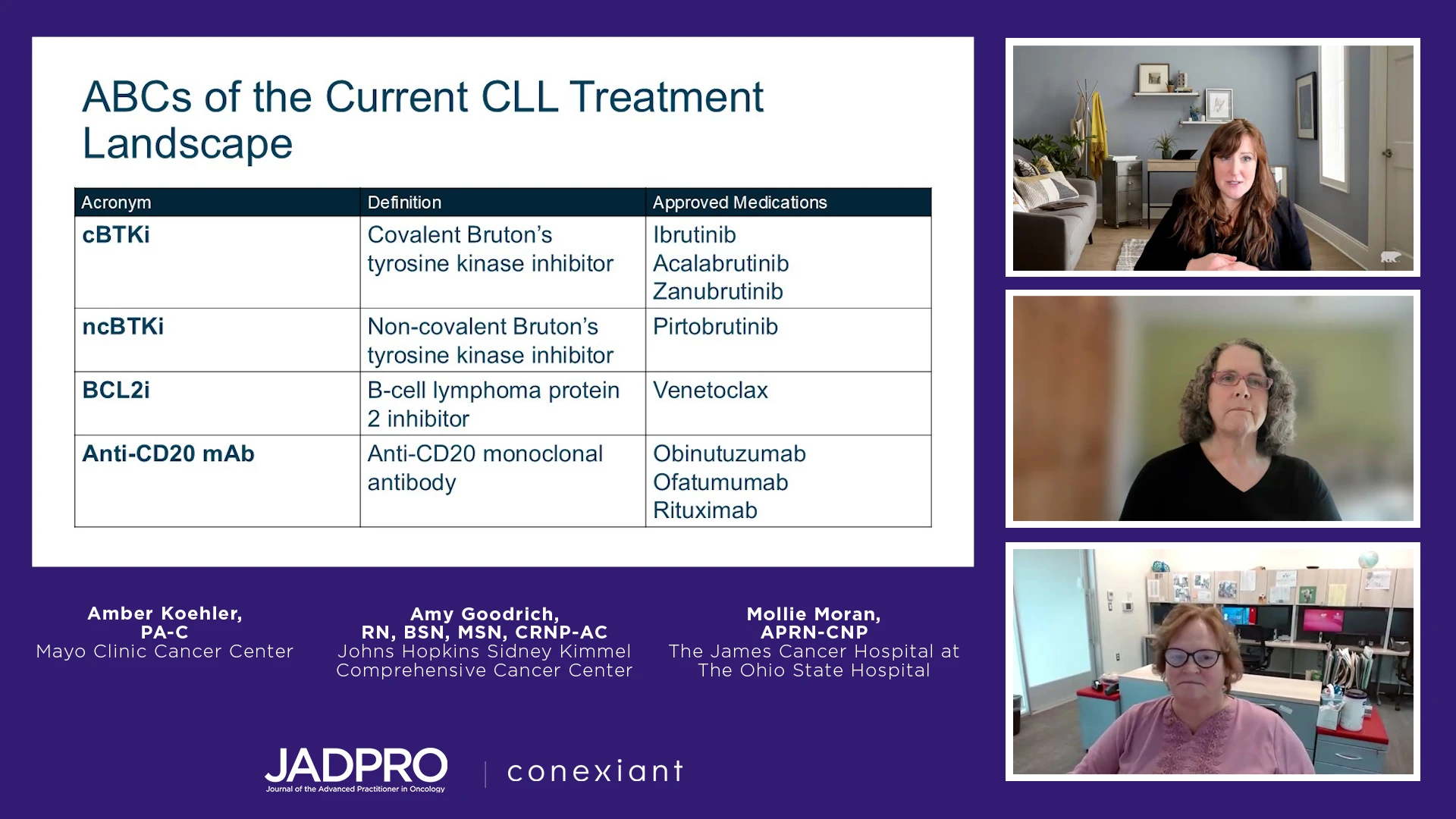
Yes. And then, for him, again, he had measurable residual disease after his VenO, and he stayed in remission about 3 years. We know that folks with 17p deletions getting VenO in the frontline setting are going to come out of remission about half as, they stay in remission about 50% longer than folks who don't have those 17p deletions, so not thrilled about trying a venetoclax obinutuzumab again, and so really, talking to him about covalent BTK inhibitor therapy. We ordered covalent BTK inhibitor therapy for him, and acalabrutinib ended up being his insurance carrier's preferred agent. And if you remember the NCCN guidelines, acalabrutinib and zanubrutinib are the preferred covalent BTK inhibitors.
We're going to get him started on acalabrutinib, but thinking about what we're doing with this guy, so he still has his well-controlled hypertension, well-controlled diabetes, but he's an older guy. Our NCCN guidelines say that we should do a baseline cardiovascular risk assessment for patients initiating BTK inhibitors. What are you doing? And it doesn't say what you should be doing. Amber, what are you doing as a baseline cardiovascular risk assessment?
Amber Koehler:
Yes, I think the crux of this is a really strong history in physical exam at a bare minimum. Understanding, for example, this gentleman has hypertension, are there enough concerns based on his history and his exam that you want to order an echocardiogram? Maybe looking for any sort of left atrial enlargement that might then predispose this patient to an atrial arrhythmia. You certainly can consider an EKG, a really good physical exam. If it sounds nice and regular, how much utility is there in that? I'm not certain. But I think these are the really relying on our exam skills, our history taking skills are very important.
Mollie Moran:
I agree, and you said he had well-controlled hypertension. Those are the big key cues that you look for. Is their hypertension well-controlled? Is there anything in their medication list that maybe their hypertension is well-controlled, because they're on three anti-hypertensives, then that kind of makes a BTK inhibitor maybe not so appealing.
Amy Goodrich:
Absolutely.
Mollie Moran:
But certainly, as Amber said, a good history and a good physical and baselines, and we have an advantage of using cardio-oncology as well, so patients who go on to BTK inhibitors with any sort of cardiac history, we can refer them into a specific cardiology clinic, but having an open dialogue with their cardiologist is a good thing as well.
Amy Goodrich:
Yes, absolutely. One of the things I look at is in our days, the EMR is a blessing and a curse, but if folks really have never had an EKG and we don't have one on file anywhere, I do, at a minimum, try to grab a quick EKG if they're not high-risk and don't need to go to cardio-oncology just to have an EKG on file somewhere. But I agree with both of you about a good risk assessment and then tailoring from there.
Mike starts acalabrutinib, everything heads in the right direction. His white count, his lymphocyte count heads down, his hemoglobin and his platelets head up. He tolerates it well, just a little bit of nausea, some intermittent loose stools. He's got some easy bruising, but no spontaneous bleeding. He's doing well.
He comes for a 6-month follow-up visit on acalabrutinib, and he notes new, painful skin lesions and cracking of his fingers, and they're bleeding when he plays golf and he plays pickleball. This is a really active guy who now has these painful lesions on his fingers and cracks that are bleeding. We tried some topical steroids, he got some doxycycline. Our NCCN guidelines really suggest dose-reducing before switching agents, and we were pretty confident this was EGFR as off-target effect from the acalabrutinib. What are you two doing with approaching dose reductions vs changing the agent, changing the BTK inhibitor? How are you approaching this?
Amber Koehler:
I would say, we always will dose-reduce first and try and manage through the toxicity, unless it is exquisitely severe. But generally speaking, we are dose-reducing managing toxicity before talking about switching gears.
Amy Goodrich:
Okay. Mol, what are you doing?
Mollie Moran:
The same with a little twist maybe that if the toxicity is something that you know is really going to improve, you try not to dose reduce unless you absolutely have to, and everybody agrees with that. We all nod our heads and say, "Yep, stick it out, stick through it." But when these ones that affect quality of life, and they're harder to make a decision of whether to stop therapy or to reduce or change therapies, and if you know that you can switch within the same category of drugs, have great efficacy and maybe not have this as a side effect, then it might be the better option to just go ahead and switch and not write it out because the longer you dose-reduce, you may have trouble down the line, who knows whether you cause resistance or not.
Amy Goodrich:
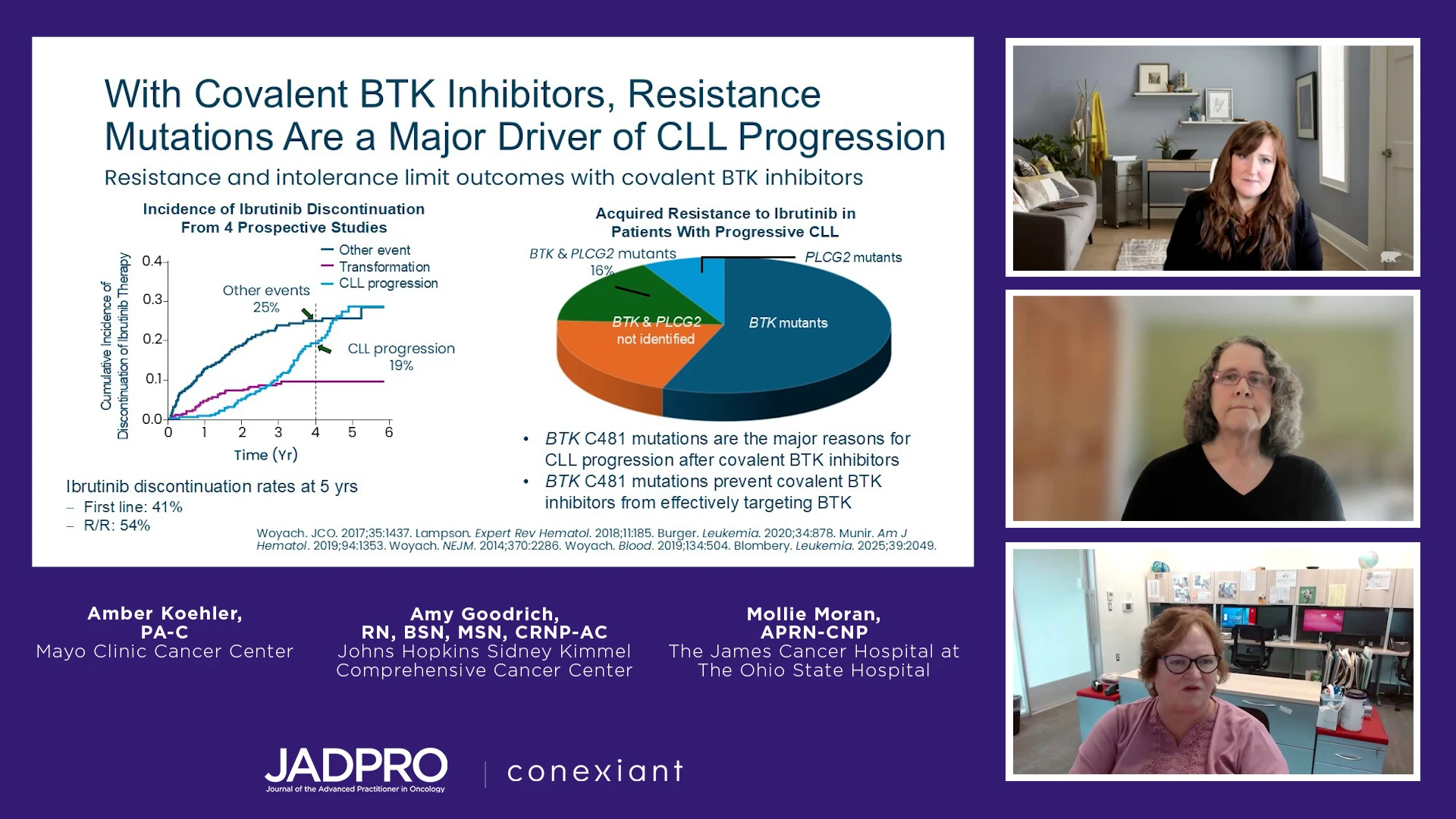
Yes. I wish I would've taken better pictures of this guy, but you can see the picture of his hand and they do crack and bleed when he's active. We held his acalabrutinib for a week and those skin lesions, like 90% improvement, so we were really confident that it was EGFR off-target effect. At that point, we were able to get zanubrutinib approved and ordered, and he started zanubrutinib with no further skin toxicity. He tolerated it well, but about two years after the zanubrutinib, and this guy is very adherent, no adherence issues with him, he starts developing increasing lymphocytosis, and we send off testing and he does have a C481 mutation. That takes a while, but by the time we figured that out, we were talking to him about next therapy because clearly he's progressing through the zanubrutinib.
And then, what is next for this guy? Thinking about our guidelines, Mollie, you very nicely talked about pirtobrutinib, you talked about CAR-T. We've got to have people in, optimally, you have someone in a good remission taking them to CAR-T. And so really, pirtobrutinib is the next therapy for this guy. We're really running out of options here, and we still do run out of options, unfortunately, in CLL. Of course, if we had a trial for him, he would've gone on a trial. Would you guys be talking to him solely about pirtobrutinib at this point, having a pretty short remission to VenO and then progressing through his covalent BTK inhibitors? What else are you guys thinking?
Amber Koehler:
Yes. I think transitioning to pirtobrutinib and having him see a CAR-T specialist concurrently would be something we'd be thinking about for a 72-year-old who is healthy, active. Mollie, what do you think?
Mollie Moran:
I agree. I think that when we talk about getting to any kind of cellular therapy, Amy, you hinted at this, is that the people who do the best are the ones who have the least amount of disease with the least amount of exposure to therapies. And so, a single agent next-line therapy that may be helpful to bring down the amount of disease is certainly something like pirtobrutinib, and then start to broach the subject of CAR-T cell therapy afterwards, because like you said, the field gets narrow unless you start to look at clinical trials. Even using combinations of the medicines that he's already had, we're going to see shorter remissions in someone like this. And so, cellular therapy, whether it's a CAR-T or something like a bispecific antibody, which is similar to CAR-T but different, could be, but that's again, clinical trials.
Amy Goodrich:
Exactly. Exactly. We did start him on pirtobrutinib relatively recently, and then he is very interested in CAR-T therapy. Again, he's a really healthy, active guy, so we're trying to get him debulked with the pirtobrutinib. It's convenient when you are a CAR-T center, but for those of you in the community, hopefully, this is somebody that you're sending to your CAR-T center pretty quickly for consideration. That's it for Mike.
Amber Koehler:
Wonderful. Well, thank you, Amy. That's a great case illustrative of a very front-to-end journey of patients with CLL these days. That brings us to the end of this roundtable discussion. Please see our other two videos for further discussion on second-line plus CLL therapy at JADPRO.com.