

Navigating 2L+ CLL Treatment: Sequencing Strategies, Guideline Alignment, and Real-World Patient Considerations
Video 2: Alignment & Common Pitfalls In Post-BTKi Sequencing
Amber Koehler, PA-C, Amy Goodrich, RN, BSN, MSN, CRNP-AC, and Mollie Moran, APRN-CNP, discuss navigating the complex treatment landscape for relapsed and refractory chronic lymphocytic leukemia and small lymphocytic lymphoma. They emphasize the necessity of repeat biomarker testing, specifically TP53 status and del(17p), to guide therapy sequencing at disease progression. Our AP experts analyze strategies for overcoming resistance to covalent BTK inhibitors, highlighting the clinical utility of noncovalent options like pirtobrutinib and BCL-2 inhibitors such as venetoclax. They also examine CAR T-cell therapy and address critical decision-making factors, including treatment duration and patient lifestyle, to ensure optimal personalized care.
Chair

Amber Koehler, PA-C
Mayo Clinic Cancer Center
Faculty

Mollie Moran, APRN-CNP
The James Cancer Hospital at The Ohio State Hospital

Amy Goodrich, RN, BSN, MSN, CRNP-AC
Johns Hopkins Kimmel Cancer Center
Transcript
Amber Koehler:
Welcome to this virtual round table about Navigating Second-Line-Plus Treatment in CLL: Sequencing Strategies, Guideline Alignment, and Real-World Patient Considerations. My name is Amber Koehler and I'm a PA at Mayo Clinic in Rochester, Minnesota. Joining me today for this discussion are Mollie Moran, a nurse practitioner from James Cancer Hospital at The Ohio State University in Columbus, Ohio, and Amy Goodrich, a nurse practitioner at the Johns Hopkins Kimmel Cancer Center in Baltimore, Maryland.
Thank you both so much for joining me today. In this video, we're going to be talking about alignment and common pitfalls in post-BTK inhibitor sequencing, and Mollie is going to take the lead. Mollie, why don't you go ahead and get us started?
Mollie Moran:
Thanks, Amber. When we talk about patients with CLL who are relapsing, it's not one heterogeneous group. We have to look at each individual relapse and see what treatment they've had before. What does their disease look like as it's relapsing? Is it being aggressive? Is it a fast relapse? Is it a slow relapse? Because you can have two different points of time when you're talking about the treatment of CLL and the relapsed/refractory setting.
So there is the time of disease progression, and then there's the time to next treatment. And those points can be very far apart and it's important to remember that as you're going through the evaluation of when you're going to start treatment again. And we talked previously about the guidelines of when do you start treatment, kind of line up just like you did when you need treatment.
But before you start treatment for relapsed/refractory disease, there is some additional testing that the patient should go through as you're making your decision tree. You should look at their cytogenetics and their FISH again, and to make sure that they haven't picked up additional cytogenetic abnormalities, particularly something like a 17p deletion or a p53 mutation. Those things can change over time. You can pick those up as you're going, as your disease is progressing.
You don't need to recheck things like immunoglobulins, the heavy-chain mutation, because that is what it is. That's the one you get, that's the one you keep. You don't go from being mutated to unmutated. And you can look also to see if there are resistance mutations to treatments that the patient might already have been receiving. So you look for resistance mutations to the BTK inhibitors. Is that what most of you folks do as well?
Amber Koehler:
Yes. And I think the other thing I'd add too, you have it here, is looking at the karyotype and doing that CpG-stimulated karyotype.
Mollie Moran:
Oh, yes. I'm sorry.
Amber Koehler:
Yes, we do know that the more complex your karyotype, the shorter the length of remission is, particularly with these more time-limited regimens. So that's the one thing I would add.
Mollie Moran:
Thank you.
Amy Goodrich:
Yes, I definitely, definitely agree with you, Mollie. You have to recheck those and make sure you understand what's going on with the disease.
Mollie Moran:
And so you gather all your data, you decide that it's time for the patient to go on and get an additional change treatments or move therapies. And so you turn to the NCCN guidelines.
As the patient is relapsing, you decide that it's time for them to go onto another therapy. And when you look at the NCCN guidelines, it lays it out as, what did you have in your previous therapy as what you should use in the next therapy, whether it was a BTK inhibitor or a BCL-2 inhibitor, was it a combination? Was it a covalent BTK inhibitor, a non-covalent? Was there an antibody attached to the regimen? And then you pick the next one.
And for the commonsense side of looking at things, it's if you've had one, then you try the next category. So if you were on a BTK inhibitor, then you would think about doing a BCL-2 inhibitor. If you were on a BCL-2 inhibitor, you would think about switching to another one. It depends on what the length of time is between when you had therapy and when you relapsed. If you had a BCL-2 inhibitor like venetoclax 8 years ago and got a long response out of it, it wouldn't be unreasonable to do that regimen again. And so looking at what a patient's already had, what their cytogenetics look like, what does their performance status look like, then you start to pull into consideration things like, how convenient is it for a patient to receive these therapies? They may be oral therapies, but they do require some office visits.
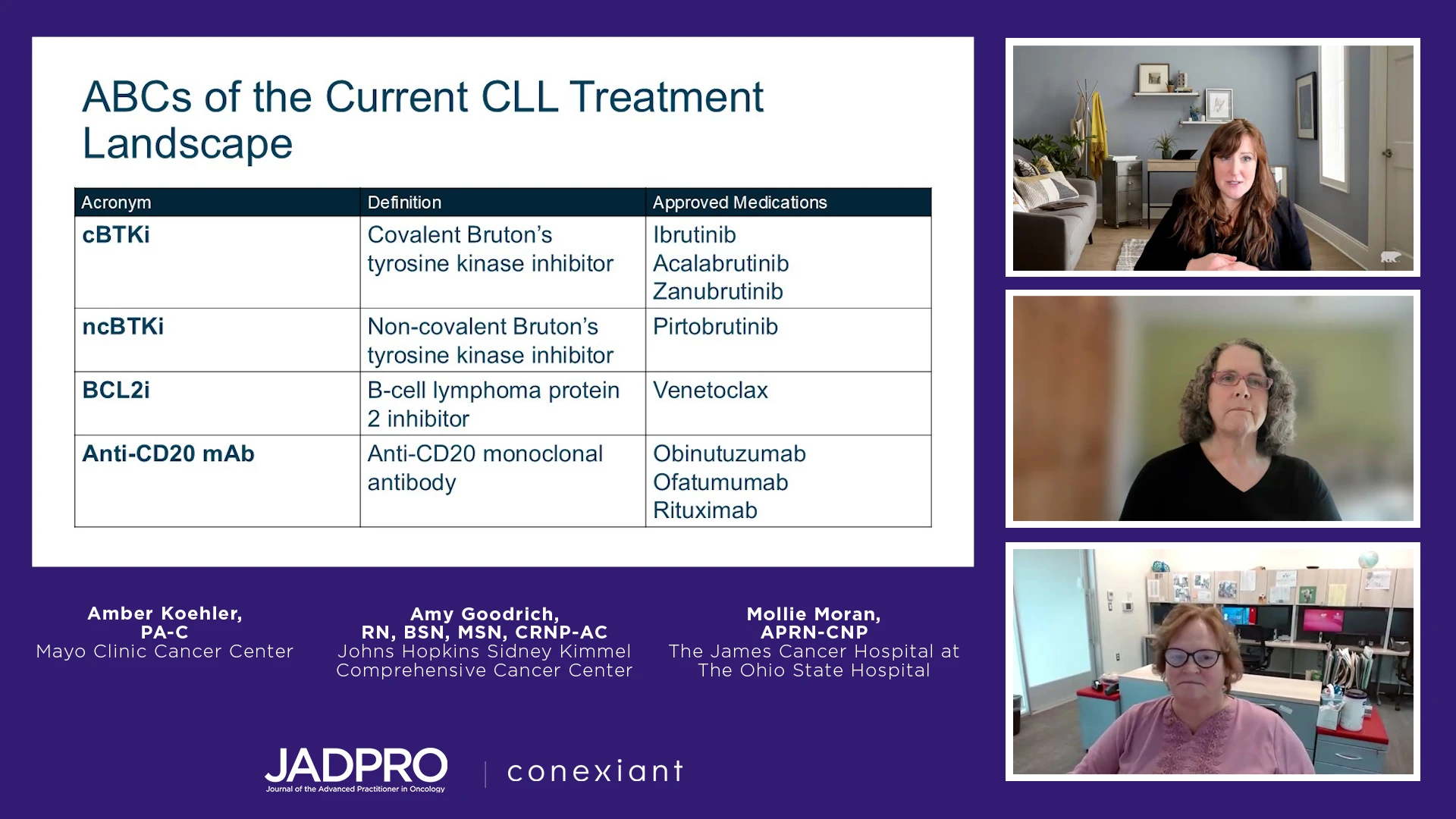
When we look at the post-covalent BTK inhibitor progression, we should talk about what's covalent and what's not covalent. So in the BTK inhibitors that we consider covalent, that would be the ones that are ibrutinib, acalabrutinib, and zanubrutinib, and then non-covalent BTK inhibitors are pirtobrutinib. It’s the one that's approved for treatment. And there is a difference in the way that these therapies target the Bruton's tyrosine kinase in the CLL cells. And in a couple of seconds here, we'll get to some more talk about what does that mean in how these therapies work so differently.
If a patient is relapsing and they're currently on a BTK inhibitor, they're likely on a covalent BTK inhibitor from their frontline therapy, or it could be a second-line therapy as well. But what happens is patients over time develop a resistance mutation. And that resistance mutation makes the BTK inhibitor no longer work. There is another class of BTK inhibitors, the pirtobrutinibs, the non-covalent BTK inhibitors, and they work whether or not you have a resistance mutation to Bruton's tyrosine kinase inhibitors. They also work after a BCL-2 inhibitor.
Another category of therapy that you can think about in a relapsed setting in CLL is CAR T-cell or biologic therapy. And sometimes pirtobrutinib, which is a non-covalent BTK inhibitor, is used as a bridge to get a patient into CAR T-cell. The mutations that develop in BTK inhibitors are a major driver of progression. Patients don't often come off therapy for intolerance or side effects. Most often patients develop these resistance mutations and they have to come off therapy because of that. There is a clone of CLL that is no longer responding to the BTK inhibitor and it starts to take off and causes all those symptoms and signs of a relapse that we keep talking about with the rise in counts and the lowering hemoglobin and the not feeling well and fatigue. Is this what you guys tend to see in your BTK inhibitor patients?
Amy Goodrich:
Yes. And the question is, in academic centers, we're looking for these mutations, we're looking for these to try to figure out exactly which of these, in this pie chart, which of these mutations patients have. What do you guys feel about folks in the community? Is this really necessary if someone is adherent to a covalent BTK inhibitor and is taking it and progressing? I know you ladies are doing this, but is this really necessary?
Amber Koehler:
It's a fair question. I mean, if you have the phenotype of progression, at this point in time, given the data that we have and the choices that we have for next line in therapy, does that finding change your management? And one could argue that right now, maybe not. So I think when there's more data, that will potentially become more beneficial. And obviously the more data comes from checking it and from larger trials and those sorts of things. But it's a fair question whether or not it changes management.
Mollie Moran:
The other thing I think about with this, Amy, is that in having a resistance mutation show up doesn't necessarily mean you're relapsed and you're changing treatments. And you can have a resistance mutation, that clone can grow very slowly over time. And you can have a positive resistance mutation for many years, and not change it, right?
Amy Goodrich:
Yes.
Mollie Moran:
But I think it's a valid question, what do you do with it? And in the community, I don't know how easy it is to get or not get, but I think it's something worth maybe checking once in a while, once in every year, couple of years, when someone's on an oral BTK inhibitor. This is a graphic that shows where the resistance mutation happens around C481, and what does covalence mean? The way that it bonds in that Bruton's tyrosine kinase, it binds a little bit differently. And so even the cells that are resistant, it doesn't matter when you use a non-covalent BTK inhibitor.
Another option for relapsing after a BTK inhibitor would be venetoclax or a BCL-2 inhibitor with obinutuzumab or rituximab. When you look at the MURANO study, we talked about this data previously, that when you compared it to bendamustine-Rituxan, obviously they did better in progression-free survival, overall survival as well, there was a benefit.
And so BCL-2 plus CD20 monoclonal antibody, which we refer to as time-limited therapy, which is always a nice option for patients. And if that was an option for them so that they wouldn't have to be on therapy for the long haul, BTK inhibitors, you usually take until they don't work. Same thing with pirtobrutinib, you take it until it no longer works. Although, that length may not be as long as the BTK inhibitor worked, but it can still be a long time and it's a pill you'd have to take every day. Whereas, these other combination therapies may be time-limited. Meaning, you only have to take them for 2 years, and that would be nice to be off therapy.
When you talk to patients about what you're going to do in the relapsed/refractory setting, and suppose all things are even, the playing field's even, and the options are non-covalent BTK inhibitor vs BCL-2 inhibitor, how do you present that to your patients? How do you get their input as you're trying to help them make a decision?
Amy Goodrich:
I mean, we just lay out the options and talk about the response rates, the length of response, the side effects, the visit schedule, that really tends to–between the side effects, the visit schedule, infusions, no infusions–those are things that really drive patients to lean one way or the other. So it's really just educating your folks and making sure they understand the whole buffet of options that they have, and letting them decide because there are many points of decision-making that there are not wrong or right answers, and we have good options regardless of what they choose.
Mollie Moran:
Agreed. One of the biggest side effects of starting a BCL-2 inhibitor is the risk of tumor lysis syndrome, which requires that, when people get started on therapy, there's a lot of upfront heavy hitting visits that if you are living at a distance or not able to drive, or elderly, that may preclude you from being a good candidate from getting a BCL-2 inhibitor to start. And I think that's an important discussion to have with patients as well, as you said, Amy, is the clinic schedules, that heavy load in the beginning and that risk of tumor lysis syndrome where you start to bust up your bad cells too quickly and you get this over-accumulation of byproducts, including potassium and phosphorus and all the debris that comes out of cells, uric acid, and LDH.
And it requires frequent monitoring. And they've just changed the guidelines about how to monitor when there's low-risk disease, but you have to identify whether a patient's low risk or high risk of having tumor lysis syndrome, the type of cancer that they have, whether it's a high-grade lymphoma or an acute leukemia or rapidly-proliferating tumors, they tend to all have higher risk of tumor lysis syndrome. So you do CAT scans to make sure they don't have big lymph nodes, you do peripheral blood counts to make sure they don't have a high lymphocyte count.
If you have a big spleen, you want to make sure that that's noted as well. If you have a preexistence, like if your kidneys aren't working so great with some renal insufficiency, and then if you're on other nephrotoxic agents, then there's a formula that you put this all into and you determine whether they're low risk, high risk, or medium risk. And that determines whether it's safe to do it as an outpatient with frequent monitoring or if patients need to be given this medicine in-house. In all cases, it's a slow ramp up to get up to a full dose to sort of mitigate some of that risk of tumor lysis.
So CAR T-cell therapy is an interesting new way of treating hematologic malignancies. It's using your own body's immune system to recognize and destroy the bad cells, the CLL cells. There are CAR T-cell therapies where they take your cells out, rev them up, teach them how to look for your cancer cells, infuse them back in, and then those T-cells that have been stimulated, drive your immune system to come and destroy and recognize the bad CLL cells. There are also CAR T-cells that are generic T-cells that sit on the shelf, that they can bring in. The ones that we use in CLL are the ones that are harvested from the patient, revved up, and put back in.
It's often given as a second-line or a high-risk disease patient would be considered for CAR T-cell. You have to have failed a previous BTK inhibitor, and so you've regressed on something like acalabrutinib or zanubrutinib, and then this becomes a second-line therapy. It's not without its risks, but it has high benefit and it has potential to be something that could be curative in CLL.
We'll sort of tie it all up here. When it comes to making decisions for relapsed/refractory CLL, one of the bigger questions is, are you going to do time-limited therapy or ongoing therapy? In that discussion with the patient, it's the number of office visits required. How heavy is the office visit load? The cost of therapy is sometimes prohibitive.
We never try to treat patients based on cost of therapy, but I think we have to make sure that it's either covered for them. You don't want to send somebody to paupers’ prison, as my grandma would say. You'd think about options for therapy down the road. Will there be a CAR T-cell transplant in their future? What kind of concurrent medications are they on? CYP34 inhibitors are always a problem with BCL-2 inhibitors. So venetoclax has a lot of interactions with a lot of different drugs, and some of the drugs are necessary for cardiac function, and then you need to verify and do med list checks.
When you're going to time out, if you're going to do a CAR T-cell, which would be a biological or cellular therapy, when are you going to put that in the lineup of treatment? How soon, how much later? We always want to test for resistance mutations. And then we talked about testing for additional genetic mutations as well. Anytime you change therapies, whether it's the second-, third-, fourth-line, well, we always check the karyotype and the FISH to make sure that they haven't been picking up more complex karyotypes because the more complex the karyotype, the more likely they are to have short-lived responses to any kind of therapy.
Amber Koehler:
I think you've covered it really well, Mollie. And so with that, that actually brings us to the end of this discussion. Please make sure to see our other two videos for further discussion on second-line plus therapy in CLL at JADPRO.com.