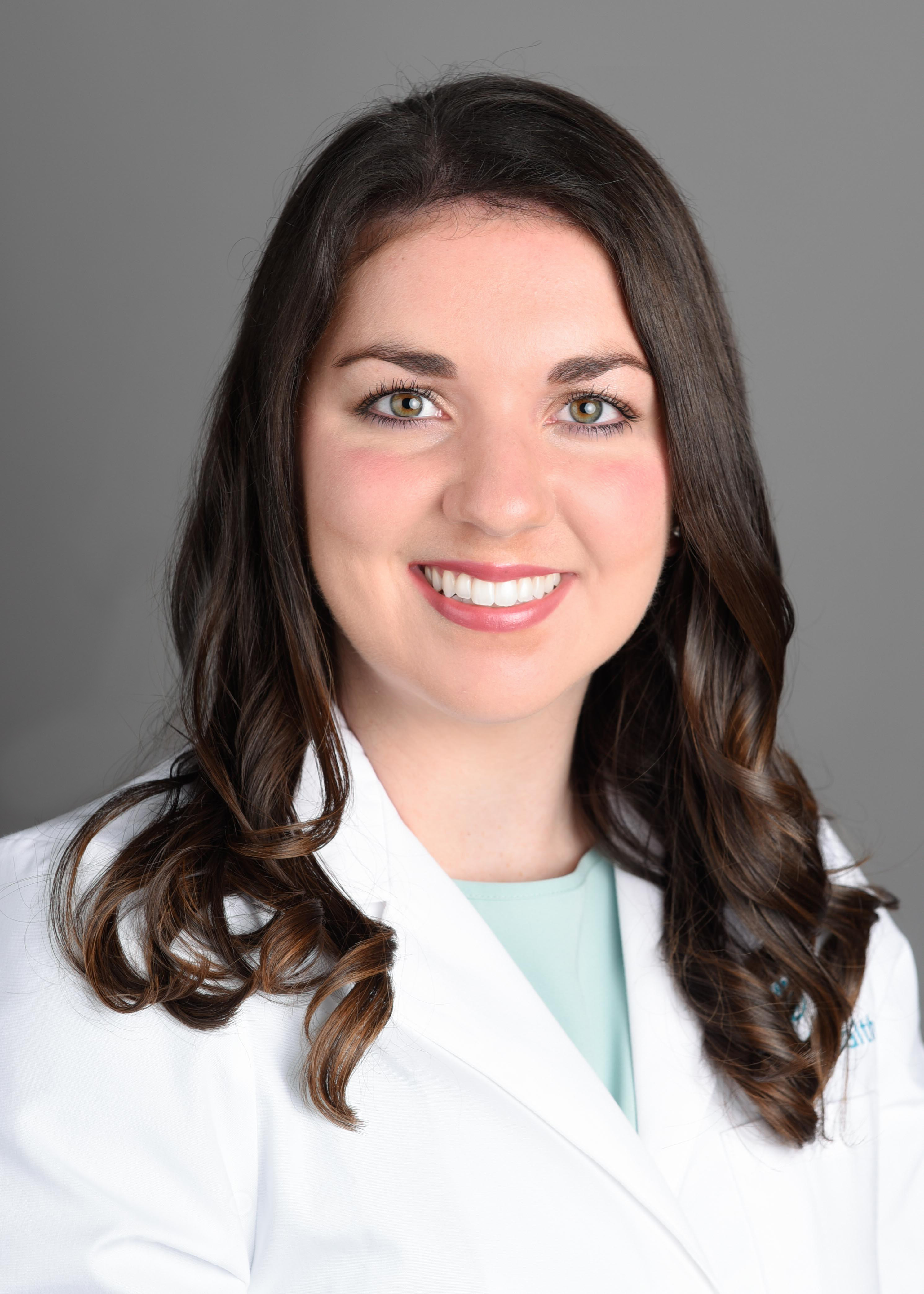
Elizabeth Dennis:
Welcome to What Advanced Practitioners Need to Know About Management Strategies in Advanced EGFR-Positive Non-Small Cell Lung Cancer and a JADPRO Virtual Roundtable. I'm Elizabeth Dennis. I'm a nurse practitioner at Texas Oncology, Baylor Sammons, Dallas. Joining me today are two of my colleagues.
Megan Van Volkenberg:
Hello, I'm Megan Van Volkenberg. I'm a physician assistant with Levine Cancer Institute, Atrium Health,, in Charlotte, North Carolina. I cover the hematology oncology infusion clinic and also help support our phase I clinical trial patients.
Chaely Medley:
And I'm Chaely Medley. I'm a thoracic oncology nurse practitioner working at Novant Cancer Institute in Winston-Salem, North Carolina.
Elizabeth Dennis:
Thank you for joining me, ladies. This is part three of a three-part series on managing advanced EGFR-positive non–small cell lung cancer. The video will focus on optimizing outcomes for our patients, through precision biomarker testing, strategic frontline sequencing, and proactive management led by advanced practitioners.
Ordering comprehensive molecular testing, or NGS testing, at diagnosis is extremely important. We can either consider both tissue and liquid biopsy, however we prefer tissue. Minimizing delays in obtaining actionable results is important, as well as ensuring EGFR mutation subtype, and co-mutation status, are identified before finalizing long-term treatment plans.
Chaely, if you have a patient waiting on NGS testing or who has a high burden of disease, is there anything that would direct your treatment options for these patients who may not have testing back?
Chaely Medley:
Yeah, so for a patient who comes into the clinic and they are maybe not incredibly sick, this was an incidental finding, something of that nature, but they're relatively young, never-smokers, then definitely I want to wait for NGS. I can send a liquid biopsy when they're in the clinic, and then I'm going to prioritize getting that tissue biopsy with the bronch.
For patients, I would encourage them to wait. It's stressful, it's worrisome, but I would encourage them to wait because we need to start with directed therapy when we can.
For patients that come in with a very high disease burden, I would still prioritize NGS testing with liquid biopsy and a bronch, but I'd probably get them started on a platinum plus pemetrexed, so that we could go ahead and start targeting their cancer in some way. This would be without the addition of immunotherapy, because we know that patients that have EGFR mutations and go on to get EGFR inhibitors will have more toxicity from these drugs if they've received a PD-L1 inhibitor.
So, this is strictly carboplatin plus pemetrexed, or cisplatin plus pemetrexed, if that's in your practice. And then once those results come back, we can pivot if we need to.
Elizabeth Dennis:
I agree. And like Chaely said, anxiety can be really high here when they're waiting on testing. They just got a diagnosis, they have cancer. Why are we waiting on this testing? What are we doing?
But if the patient is pretty asymptomatic, it's important to educate them on why waiting is important. It allows us to determine specific genetic changes that we can specifically target. So, obtaining those results as a provider and ensuring the patient of why we're waiting is very important.
Initiating treatment while awaiting results. Balancing urgency of treatment with the value of complete molecular information, as Chaely said, can happen. We need to consider disease burden, symptom severity, CNS involvement, and performance status of the patient.
We need to look at avoiding therapies that may complicate future sequencing when clinically feasible, and maintain close communication with our patients regarding testing timelines and treatment rationale.
Just curious, Chaely, what's the typical turnaround for your NGS testing, as far as tissue?
Chaely Medley:
A tissue turnaround for us would be 2 to 3 weeks, and that 3-week mark gets real stressful when we're wanting the answer and we're just waiting and waiting.
Elizabeth Dennis:
I agree. And a lot of that depends, Chaely, as you probably know. If they've already received the biopsy before coming to us in clinic, we may have to outsource and get that biopsy and tissue sent to the NGS, and there can be some lag time there. So, ensuring that we do that first visit and get that out as soon as possible, is critical.
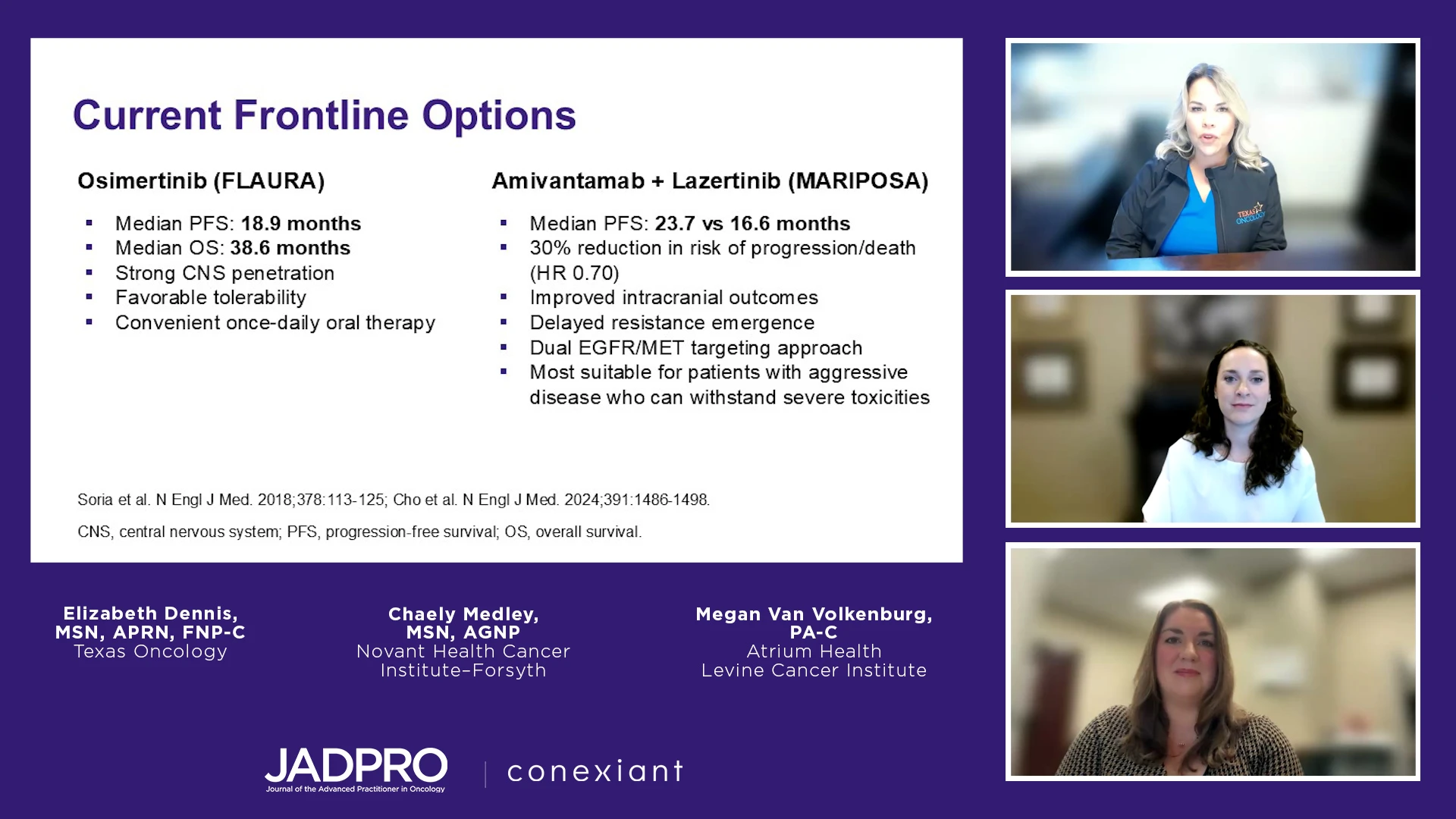
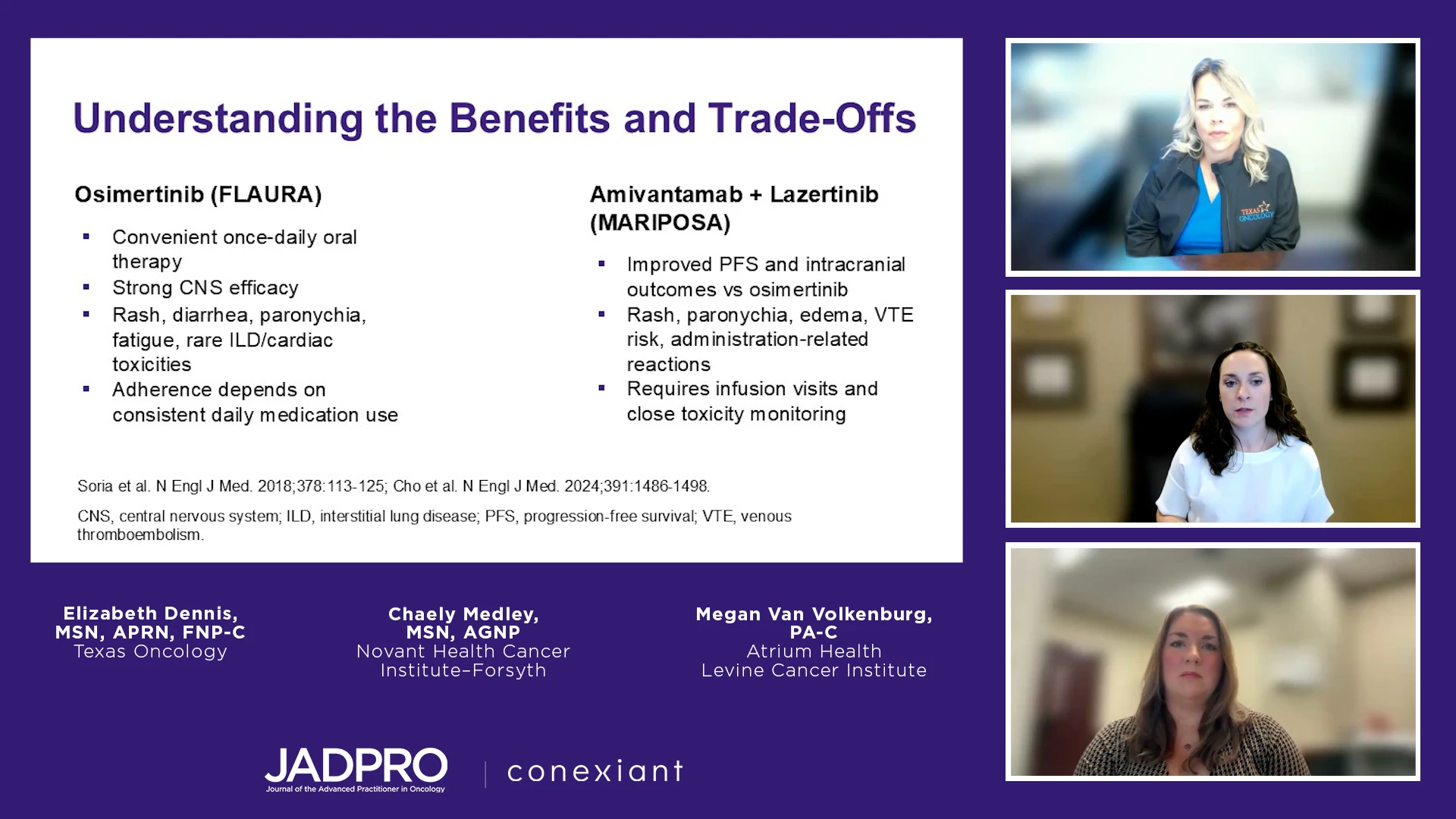
So, sequencing in a rapidly involving landscape. We've come a long way with EGFR-positive treatment and our current frontline options in a very short time. We have osimertinib alone, the FLAURA trial, amivantamab plus lazertinib in the MARIPOSA trial, which was the IV formulation of amivantamab. Now we have the subcutaneous amivantamab plus lazertinib in the PALOMA-3, as well as osimertinib plus platinum or pemetrexed in the FLAURA2, as well as clinical trials.
So continuing on those key clinical decision points. Sequencing considerations are important. CNS disease control, resistant mechanisms at progression, future targeted therapy opportunities for patients, as well as clinical trial eligibility, and preservation of performance status and quality of life is very important.
The role of advanced practice providers is critical to coordinating biomarker testing and follow-up, educating patients and caregivers, facilitating shared decision-making, managing those treatment-related toxicities, as well as monitoring adherence and treatment persistence.
Identifying barriers to care, such as financial, transportation, caregiver support, as well as coordinating care across community and academic settings is important.
Chaely, what are your thoughts on APPs, and how they help these patients and direct care through EGFR-positive, non–small cell lung cancer diagnoses?
Chaely Medley:
I think that, at least in my practice, I play a really important role of helping keep an eye on the patient. I can do a lot of toxicity checks. It's easy for me to bring the patient back and say, "Can you please come back next week?" because I don't have a lot of new cancer patient slots, and so I'm kind of open to see these patients and help manage more of their toxicities.
I think a big role that I play with the management of these patients is the education. Our pharmacists will educate the patient on the drug, but actually tying this into, how does what this information they just got about what the drug is and what it's going to do to their bodies actually relate to them as a person and to their cancer? And, how are we going to keep an eye on this, and how are we going to keep up with it with imaging and things like that?
I enjoy that aspect of helping care for the patients, and I think they really appreciate it and respond to that also.
Elizabeth Dennis:
I agree. What are your thoughts, Megan?
Megan Van Volkenberg:
I agree with what Chaely said. I think that was really well put.
For an infusion side, we're doing reeducation. We're building on what you guys have already worked so hard with your pharmacy team, your provider team, nursing team, and getting all those multidisciplinary teams arranged. We can really be that regular stopping point in infusion, where the APPs can take some time, sit down with the patients, their caregiver, have some conversations about how they're tolerating treatment, what their concerns may be, if there's any new barriers that may have come up since their last visit with clinics so we can bring that to everyone's attention.
And just to go along with that, even though we're more of a supportive oncology role, we're not the main primary oncology team. All of the different supportive oncology practitioners, we all have a duty to report anything new, any new concerns that patients are bringing up, even if it's not our area of expertise or we're not exactly sure what the next step would be. Just having that direct communication to the providers so that you guys can review it, see if it's clinically relevant, important, be able to communicate with the patients, so we can keep them adherent on therapy and make sure that they feel comfortable and like they have all their questions answered.
Elizabeth Dennis:
I agree completely. It takes a multidisciplinary team, and all the efforts of the APPs in clinic and in the infusion center, to make sure that we're managing these toxicities, educating our patients to ensure that we can keep them on treatment for as long as possible, but with also giving them the best quality of life.
So, ongoing management of those early toxicities and monitoring as we've discussed. Adherence to support and patient education for the patients, CNS surveillance, repeating liquid and/or tissue biopsy at progression is very important, especially in a new site. An assessment for clinical trial opportunities at frontline and second line is important as well.
Reassessment of goals of care throughout treatment is critical to ensure that we're basing our treatment on what the patient's goals are, whether that's quality of life, longevity of life, whatever that looks like, making sure that we're there as their caregivers to provide them what their goals of treatment are.
Any other thoughts on that, ladies?
Chaely Medley:
The only other thing I would add is just, as an APP, I do feel like we have a little bit more of a direct line to some of our colleagues that are in industry. And I'm definitely more likely to call on an MSL and say, like for osimertinib specifically, I have called on an MSL to say, "Can I crush this?"
And he got back to me within 20 minutes, and was like, "You can crush it. This is exactly how much you need to dissolve it in, and this is how many times they need to rinse the cup and take the med again."
And that kind of thing, it's super helpful obviously for the patient and it's a good relationship to have. And so, a lot of our colleagues do go to industry, and keeping those ties together, so that we can communicate about managing rash, or how to take osimertinib when you have to crush it has, I think, changed my management of some of these patients with the complex toxicities.
Elizabeth Dennis:
I agree. Anything from you, Megan?
Megan Van Volkenberg:
I think you guys have done a great summary, and I just appreciate being part of the collaborative care as we care for these complex patients.
Elizabeth Dennis:
I agree. And so, successful management of EGFR-positive non-small cell lung cancer patient requires more than just selecting the first-line therapy. Timely biomarker testing, thoughtful sequencing, proactive toxicity management, and APP-led shared decision-making, are essential to optimizing outcomes across the entire patient's journey.
Thank you so much for joining us. This brings us to the end of the video. Please see our two other videos for further discussion about management strategies in advanced EGFR-positive non-small cell lung cancer at jadpro.com.